Pickleball has grown faster than almost any recreational infrastructure program in BC can keep pace with. Municipal parks departments, recreation centres, schools, strata complexes, and private clubs are all actively adding or converting courts, and the demand in the Lower Mainland specifically has produced a backlog of projects where the planning details are still being worked out.
Fencing is one of the most consequential of those details, and it is often treated as an afterthought until someone starts asking the specific questions. How high does the perimeter fence need to be? What separates adjacent courts? Do we need windscreens? What about the neighbours complaining about noise? What material holds up in Richmond or Burnaby’s wet climate without turning into a maintenance burden in year two?
This guide answers those questions specifically, drawing on Pickleball Canada’s published court building guidance and our experience installing chain link, windscreen, and specialty fencing at athletic facilities across BC.
The Pickleball Court Dimensions That Fencing Has to Work Around
Before getting into fencing specifications, it helps to understand the court footprint that the fence is built around, because the court geometry drives the setback, gate placement, and total enclosure size.
A standard pickleball court is 6.1 metres wide by 13.4 metres long (20 by 44 feet), with a 7-foot non-volley zone on each side of the net. The playing area, meaning the court plus the safe runoff zone required around it, expands considerably from those court lines. Tournament-standard runoff is approximately 2.1 metres (7 feet) behind each baseline and 2.1 metres on each sideline.
This means a single court enclosure needs to accommodate a footprint of roughly 10.4 by 17.7 metres (34 by 58 feet) at minimum to meet the recommended player runoff standards. Multi-court facilities multiply that width and need to account for the divider fencing between adjacent court pairs, shared service corridors, spectator areas, and access gate placement for each court section.
Getting the fence line right from the start of the layout process is considerably easier than discovering after installation that gate placement interferes with player runoff or that the perimeter fence was set too close to the baseline.
Pickleball Canada’s Fencing Recommendations
Pickleball Canada’s court building resources set the baseline specifications that facility developers across BC should be working from. For outdoor facilities, the recommendations are:
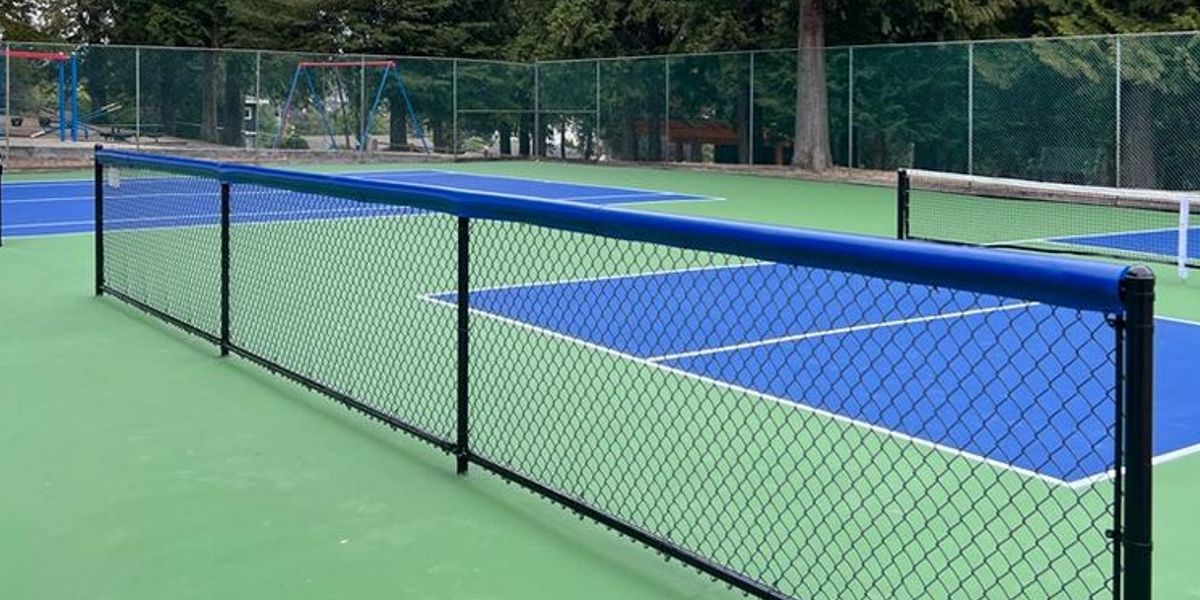
Perimeter fencing height of 3.0 to 3.7 metres (10 to 12 feet). This is the standard for outdoor pickleball courts and is the primary difference between pickleball fencing and the lower enclosures used in some other recreational applications. The height range reflects the trajectory of a pickleball ball: significantly faster and more direct than a tennis ball at similar swing speeds, and prone to clearing lower fences particularly on serves, overhead shots, and high lobs. A 3-metre perimeter fence is the functional minimum for meaningful ball containment on an outdoor court.
Divider fencing between adjacent courts at 1.2 to 1.5 metres (4 to 5 feet). When multiple courts are laid out side by side, Pickleball Canada recommends divider fencing between them to clearly separate courts, reduce ball interference between games, and create defined court boundaries that help players orient themselves during play. Divider fencing at this height is not a full ball-containment barrier, it is a court delineation structure. The perimeter fence carries the containment function.
Weather-resistant chain link or equivalent material suited to Canadian outdoor conditions. This is the recommended baseline for BC facilities for a straightforward reason: chain link at the appropriate gauge provides ball containment at the required heights, allows wind movement through the fence rather than creating a solid sail, and holds up well in BC’s outdoor environment with appropriate galvanizing or coating.
Windscreens and acoustic fencing where facilities are near residential areas. Pickleball Canada specifically flags this consideration, and it is one of the most practically significant planning decisions for urban and suburban BC facilities. Pickleball’s characteristic sound profile has generated noise complaints at facilities across the province where court development outpaced neighbourhood engagement. Addressing this proactively at the fencing stage is considerably less expensive than retrofitting a solution after the facility has opened and complaints have begun.
Appropriately located access gates. Gate placement on a pickleball court enclosure should allow player flow in and out without crossing the court itself, accommodate maintenance equipment for resurfacing and line maintenance, and not create a blind entry point where a player emerging from the gate might encounter an active ball.
Why BC’s Climate Makes Material Specification Matter
BC’s outdoor conditions are not uniform across the province, and a facility in Burnaby’s still-wet marine climate has different material demands than one in Kelowna’s dry interior. For Lower Mainland facilities, the relevant conditions are high annual rainfall, persistent ambient moisture, and in coastal-adjacent settings, the corrosive influence of salt air.
For chain link specifically, galvanized steel chain link is the standard for pickleball enclosures and performs well across most of the Lower Mainland. In the wettest and most coastal-adjacent locations, or where a facility wants a darker, less industrial appearance, vinyl-coated chain link is an option that adds a further barrier against corrosion at cut edges, post tops, and fastener points.
For post specification, galvanized steel posts in the appropriate diameter for the fence height and load conditions are the correct choice for outdoor BC facilities. The 3 to 3.7 metre height requirement for perimeter fencing means posts at greater height than a standard residential fence, which affects both the post diameter and the embedment depth required for structural stability. Post diameter and spacing calculations need to account for the combined wind load on the fence fabric and windscreen if one is included, not just the fence height alone.
At Raybern Erectors, our Willoughby Community Park pickleball court installation in Langley reflects the post specification and fabric selection appropriate for a high-use BC outdoor facility. That installation is one of several athletic facility projects in our portfolio that informs how we approach the specific load and drainage conditions of a multi-court Lower Mainland build.
Windscreens: When They Matter and What They Do
A windscreen is a knitted or woven polypropylene fabric attached to the inside of the chain link fence to block wind, reduce glare from adjacent lighting or sun angle, and in some applications provide a degree of acoustic attenuation.
For pickleball facilities in BC, windscreens serve three distinct functions, and understanding which applies to your facility determines whether they are worth the additional cost.
Wind control. Outdoor pickleball is genuinely affected by wind in a way that tennis is not, because the pickleball ball is lighter relative to its size and its flight path is more easily deflected. Courts on exposed sites, rooftop installations, or facilities with prevailing wind exposure from a consistent direction benefit meaningfully from windscreen installation on the windward fence sections. The playability improvement is real.
Visual separation. On multi-court facilities where adjacent court pairs share a divider fence run, windscreen on the divider can reduce the visual distraction of play on the adjacent court. This is more of a player experience consideration than a technical one, but it is a common request on higher-use facilities where multiple games running simultaneously create visual noise.
Acoustic mitigation. This is where windscreens need to be understood accurately. Standard knitted polypropylene windscreens provide minimal acoustic attenuation. The noise reduction claim associated with windscreens is largely about wind interference with sound propagation, not meaningful noise absorption. A facility where neighbourhood noise complaints are a genuine concern needs either a purpose-built acoustic barrier product, increased setback from the property line, or a combination of physical barriers and sound-absorbing panels that go beyond what a standard windscreen delivers.
Acoustic fencing products designed for pickleball applications are available, including rubber-composite panel systems and specialized barrier fabrics. These products cost more than standard windscreen fabric and are engineered specifically for sound attenuation rather than wind and visual separation. For BC facilities in residential-adjacent settings where noise management is a planning condition or a community commitment, a purpose-built acoustic solution is the right specification.
Multi-Court Layouts: What the Fencing Design Has to Solve
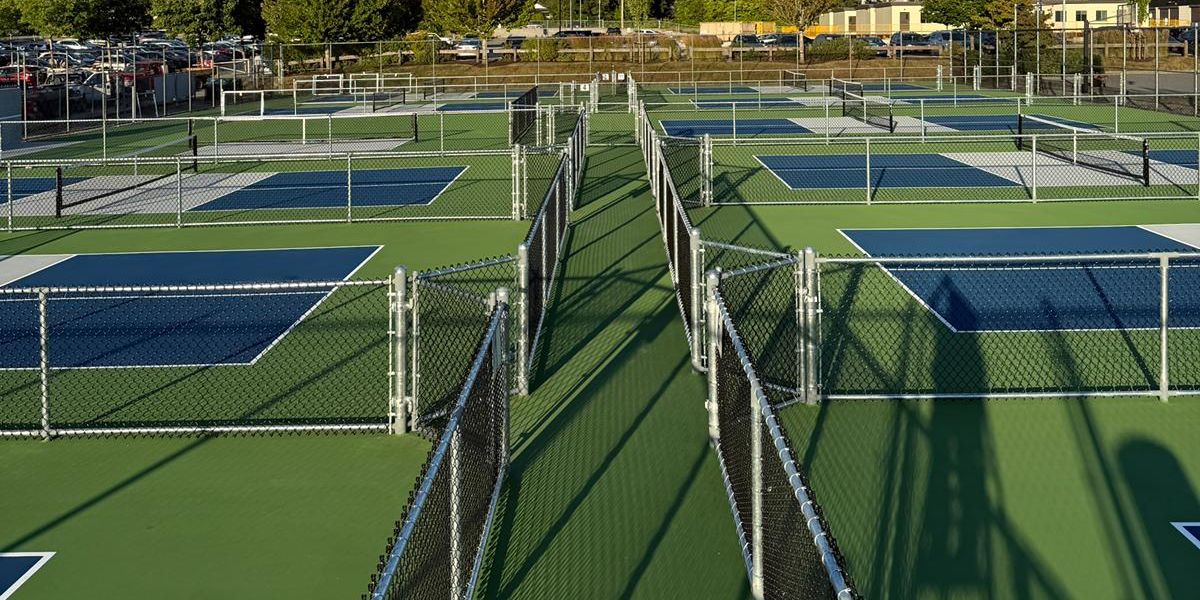
The complexity of a pickleball fencing project scales non-linearly with the number of courts. A single-court enclosure is a relatively straightforward perimeter fence with one or two access gates. A four-court or eight-court facility involves a considerably more involved layout with shared fence lines, internal divider runs, multiple gate locations, service access requirements, and potentially different fence heights or windscreen coverage on different sections of the same enclosure.
For multi-court projects, the fencing design needs to address:
Shared fence lines between court pairs. Where two courts share a divider fence, that fence needs to clearly define each court boundary at the 1.2 to 1.5 metre divider height recommended by Pickleball Canada, while the overall perimeter maintains the 3 to 3.7 metre containment height. The transition between divider height and perimeter height at the corners of each court pair requires a deliberate design decision, not an improvised field adjustment on installation day.
Gate placement for each court pair. Access gates need to allow player entry and exit without passing through an active adjacent court. On a four-court layout, this typically means gates on the end fence sections for each court pair rather than a single entry through the perimeter.
Spectator access and separation. Larger facilities often need a defined spectator area outside the playing enclosure, which may mean a second fence line or a designated viewing corridor between the perimeter fence and the property boundary.
Maintenance and equipment access. Courts need periodic resurfacing, line repainting, and net maintenance. Gate width and placement need to allow equipment access for these operations, which means gates wide enough for a power washer or small resurfacing equipment, not just pedestrian access.
Tennis Court Conversions: What Changes with the Fencing
Many of the new pickleball courts being developed across BC are conversions of existing tennis court facilities, particularly at municipal parks and older recreation sites. The tennis infrastructure, including the court surface, existing fence enclosure, and light poles, is already in place, and the conversion question is what needs to change.
For fencing specifically, the key difference between a tennis court enclosure and a dedicated pickleball enclosure is the height and the internal divider layout. Standard tennis court fencing typically runs 3 metres (10 feet) high, which falls within the lower end of the Pickleball Canada-recommended range, so the perimeter containment height may already be adequate.
The bigger change on a tennis-to-pickleball conversion is the addition of internal divider fencing to separate individual pickleball courts within the larger tennis enclosure. A standard single tennis court (23.8 by 10.9 metres) accommodates two pickleball courts side by side comfortably, and adding the divider fence between them is typically the primary fencing work required in a conversion. Gate placement may also need adjustment if the existing tennis court gates are not positioned for the new court layout.
Whether the existing chain link is in adequate condition for continued use without replacement requires a site-specific assessment of the fabric gauge, post condition, tension wire integrity, and how the existing fence handles the higher ball-impact frequency of pickleball compared to tennis.
What Pickleball Court Fencing Costs in BC
Pickleball court fencing costs across BC vary based on the number of courts, the perimeter linear footage, post specification for the required height, whether windscreen or acoustic fencing is included, and the site conditions affecting post embedment and concrete requirements.
A single-court enclosure with standard galvanized chain link at the 3-metre perimeter height, appropriate post specification, and basic gate hardware represents the baseline project. Multi-court facilities with internal dividers, windscreen fabric, and multiple gate configurations carry higher total costs that scale with the project complexity rather than simply with the number of courts.
The honest answer on pickleball court fencing cost in BC is that a free on-site assessment is the only reliable way to produce an accurate figure. Terrain, soil conditions, whether existing infrastructure can be reused on a conversion project, gate count and configuration, and the specific products specified for windscreen or acoustic applications all affect the total in ways that a per-linear-foot figure cannot capture.
What we can say is that building the enclosure correctly from the start, with appropriate post specification for the 3 to 3.7 metre height, galvanized steel components suited to the site’s moisture conditions, and gate placement designed around the actual court layout rather than improvised, is materially less expensive over the life of the facility than addressing the consequences of an underpowered installation.
Frequently Asked Questions (FAQs)
Pickleball Canada recommends perimeter fencing of 3.0 to 3.7 metres (10 to 12 feet) for outdoor pickleball court enclosures. This height range provides adequate ball containment given pickleball’s ball trajectory and the speed at which serves, lobs, and overhead shots leave the court.
Pickleball Canada recommends divider fencing between adjacent courts at 1.2 to 1.5 metres (4 to 5 feet). This height is a court delineation structure rather than a full ball containment barrier. The perimeter fence carries the containment function.
Pickleball Canada recommends durable, weather-resistant chain link or equivalent material suited to Canadian outdoor conditions. For BC’s Lower Mainland, galvanized steel chain link is the standard. Vinyl-coated chain link is an option for coastal or high-moisture sites, or where appearance is a priority.
Standard knitted polypropylene windscreens provide minimal acoustic attenuation. They control wind interference and visual distraction effectively, but facilities with genuine neighbourhood noise concerns need a purpose-built acoustic barrier product rather than a standard windscreen.
A standard single tennis court enclosure comfortably accommodates two pickleball courts laid side by side. A standard doubles tennis court (approximately 23.8 by 10.9 metres) can fit four pickleball courts, two pairs laid end to end, with internal divider fencing separating each pair.
For municipal parks and institutional facilities, the fencing is typically part of the broader court development permit process. For private facilities including strata and club installations, permit requirements vary by municipality and are generally triggered by fence height and whether the installation involves structural post footings. Confirm requirements with your local building department.
Yes. Our experience includes multi-court athletic facility installations across BC, and we are experienced with the divider fencing layout, gate placement, and post specification that multi-court projects require. We work with municipal parks departments, school boards, and private facility operators across the Lower Mainland.
Why Raybern Erectors for Pickleball Court Fencing in BC
We have direct experience with pickleball court fencing at multi-court athletic facilities across BC, including the Willoughby Community Park installation in Langley. That experience includes the specific considerations that distinguish a pickleball court enclosure from a generic sports fence: post specification for the required height, chain link gauge appropriate for higher ball-impact frequency, divider fence layout coordination with the court plan, and windscreen or acoustic product selection matched to the facility’s noise and wind exposure.
Our COR-certified crews handle every athletic facility project under formal safety management standards, and our in-house fabrication shop allows us to produce custom gate configurations and non-standard components built to the specific dimensions of your court layout. Every installation is backed by a 1-year parts and labour warranty.
If you are a municipal parks department, a school board, a strata complex, or a private club planning a pickleball facility in the Lower Mainland or anywhere in BC, we welcome the conversation.
Contact us today for a free, no-obligation site assessment and estimate.
Raybern Erectors has been installing fencing at athletic facilities across Vancouver and BC since 1964. Contact us today for a free site assessment and estimate on your pickleball court fencing project.
Related Posts