It is one of the first questions every golf course operator, developer, or facility manager asks when planning driving range containment, and it is also one of the questions with the least satisfying answer: it depends. There is no single correct height for driving range netting. The right answer for your facility could be 20 feet in one section and 80 feet in another, on the very same property.
That is not an evasive answer. It reflects how driving range netting actually gets engineered. Height is a function of golf ball trajectory, distance, wind exposure, and what exactly you are trying to protect, not a number pulled from a standard table. This guide walks through how that height is actually determined, what range of heights you should expect to see across a real facility, and what we have learned engineering driving range netting systems across BC, including our installation at Mayfair Lakes Golf and Country Club in Richmond.
Why There Is No Single Standard Height
Golf ball flight is genuinely variable, and that variability is the entire reason driving range netting height cannot be standardized the way, say, a baseball backstop height generally can be. A golf ball’s trajectory depends on swing speed, club selection, launch angle, and even atmospheric conditions on a given day. Modern equipment has also meaningfully increased how far and how high an average golfer can hit a ball compared to even a decade or two ago, which means containment systems designed under older assumptions can find themselves under-built for current player capability.
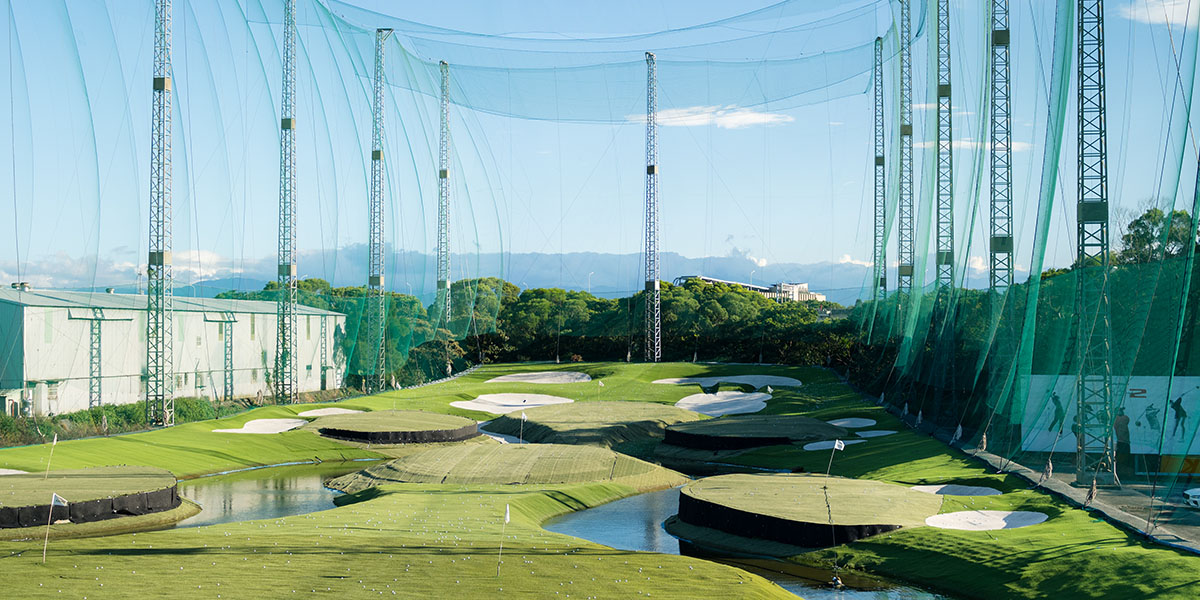
Industry data on installed driving range and golf netting systems shows heights ranging from as low as 20 feet up to 160 feet depending on the specific application and site conditions. That is an enormous range, and it exists because the variables driving the decision, distance to the boundary being protected, the trajectory of shots being hit from that specific tee position, and the level of risk tolerance the facility is willing to accept, are different at every single site.
This is also why netting height frequently varies across different sections of the same facility rather than running at a single uniform height around the entire perimeter. A section of netting close to the tee line, where balls are still gaining height, often needs to be taller than a section further down the range, where balls have already reached their peak trajectory and begun descending. Building a uniform maximum height across an entire range when only certain sections actually require it is not just unnecessary, it adds real cost without adding real protection where it is not needed.
The Variables That Actually Determine Height
Distance from the tee line to the boundary. This is the most fundamental variable. A range with significant depth before it reaches a property line, a road, or a neighbouring structure has more room for a ball’s trajectory to descend naturally before reaching the boundary, which can reduce the height required at that specific point. A compact urban facility with limited depth has far less margin, which generally pushes height requirements upward to compensate for the shorter distance available.
What is being protected on the other side. A boundary adjacent to undeveloped land carries a fundamentally different risk profile than one adjacent to a residential development, a busy road, or a neighbouring building. The level of consequence if containment fails should directly inform how conservative the height specification needs to be. This is precisely the kind of judgment call that benefits from a proper site assessment rather than a generic standard.
Player skill level and equipment. A facility that primarily serves recreational golfers and beginners has a meaningfully different trajectory profile to contain than one that serves a competitive membership with longer, higher-launching swings, or one that hosts launch monitor fitting sessions where modern equipment is being tested specifically for distance. Facilities should be honest about their actual player base when planning containment height rather than designing only for an average case.
Wind exposure. Wind affects ball flight significantly, and a site with consistent or strong prevailing winds, common across many BC coastal and valley locations, needs to factor that into height and placement decisions. A trajectory that would comfortably clear a given height on a calm day can behave very differently in a stiff crosswind.
Elevation and terrain. Sites with elevation changes between the tee area and the boundary being protected require height calculations that account for that grade difference, since a boundary sitting below the tee elevation effectively needs to contain a ball earlier in its descent than one at the same elevation as the tee.
Why Heights Beyond 50 Feet Require Structural Engineering
There is a practical threshold worth understanding if your facility is looking at heights in the higher end of the typical range. Netting systems exceeding roughly 50 feet generally require formal structural engineering input to ensure the support structure, posts, and tensioning system can safely and durably handle that height under real wind load conditions, not just under calm-day assumptions.
This is not a regulatory technicality to work around. At extreme heights, the forces acting on posts and tensioning cables during a significant wind event become substantial, and a system that is not properly engineered for those loads is a genuine structural and safety risk, not just an underperforming product. Any facility planning netting in this height range should expect, and should want, real structural engineering to be part of the design process.
Our Approach: Mayfair Lakes Golf and Country Club
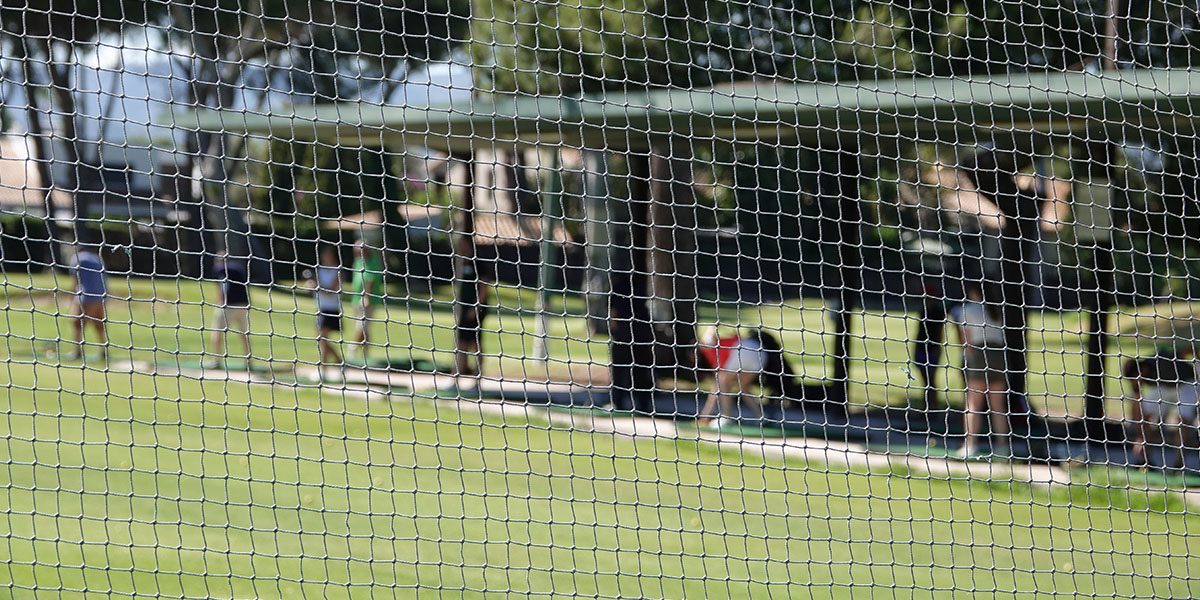
Our installation at Mayfair Lakes Golf and Country Club in Richmond is a useful real-world example of how this engineering process plays out on an actual site, since it required exactly the kind of height-and-distance calculation described above rather than a generic, off-the-shelf product.
A driving range netting project like this begins with a thorough site assessment of the range’s depth, the boundaries that need protection, the typical player profile using the facility, and any specific site conditions like wind exposure or elevation change. From there, the height and configuration of the netting system is engineered around those actual conditions, with variable heights across different sections of the range where the trajectory and distance data support it, rather than a single maximum height applied uniformly regardless of need.
The support structure for an installation in this category uses galvanized or powder-coated steel posts sized specifically for the height and load involved, combined with high-tensile cable tensioning systems that maintain consistent net plane across large spans. This is the same fundamental approach we bring to any driving range netting project, scaled to the specific height and distance requirements of your facility.
What to Expect From a Proper Assessment
If you are planning a new driving range netting system or evaluating whether your existing containment is adequate for current player capability, here is what a proper assessment actually involves rather than a guess based on a general industry range.
A thorough assessment measures the actual distance from each relevant tee position to every boundary requiring protection, since this can vary significantly across different sections of a single range. It considers what is on the other side of each boundary and the consequence level if containment were to fail at that specific point. It accounts for the actual player base using the facility, rather than designing purely for an average recreational golfer if your range regularly hosts longer hitters or equipment testing. And it factors in site-specific conditions like wind exposure and elevation change that a generic height recommendation simply cannot account for.
From that assessment, height recommendations should come with a clear rationale specific to your site, not a single number presented without explanation. If a contractor recommends a single uniform height for your entire range without walking through any of these variables, that is worth asking more questions about before proceeding.
Why Raybern Erectors for Driving Range Netting in BC
Driving range netting is one of the most technically demanding applications in the entire athletic netting category, and it is not a service every netting contractor in BC genuinely specializes in, even when it appears on a general capabilities list. At Raybern Erectors, we bring over 60 years of structural installation experience to driving range projects specifically, along with the in-house fabrication capability and engineering judgment needed to design a system around your site’s actual conditions rather than a generic specification.
Our work at Mayfair Lakes Golf and Country Club reflects the level of precision and site-specific engineering we bring to every driving range netting project. Every installation is backed by our COR-certified safety standards and a 1-year parts and labor warranty.
How Long Does a Cedar Split Rail Fence Last?
This is the other question we hear constantly, and the honest answer is that it depends heavily on site conditions, but a properly installed cedar split rail fence in BC’s climate will generally last somewhere between 15 and 25 years, and sometimes longer, without any chemical treatment.
A few factors influence where in that range a given fence will land. Ground contact at the base of the posts is typically the first point of failure on any wood fence, since that is where moisture exposure is most constant. Proper post-setting depth, appropriate concrete or gravel base preparation, and good site drainage all extend the life of the posts significantly. Sun exposure also plays a role, since rails on a south-facing, fully exposed property will weather differently than rails in a shaded, sheltered setting, though this tends to affect appearance more than structural integrity.
This is one of the genuine advantages cedar holds over other wood species used for similar fencing. Because the durability comes from the wood’s natural oils rather than an applied chemical treatment, there is no coating to wear off and no maintenance schedule required to sustain that resistance over time. A cedar split rail fence installed correctly today should still be standing and performing well two decades from now with essentially no maintenance beyond the occasional check for a loose rail or a post that has shifted.
Maintenance: What to Expect Over the Life of Your Fence
One of the most appealing aspects of cedar split rail fencing is how little it asks of you after installation. There is no painting, staining, or sealing required, which sets it apart from most other wood fencing products on the market.
That said, “low maintenance” does not mean “no maintenance ever.” Over a fence’s lifespan, it is reasonable to expect the occasional rail that needs to be reset or replaced, particularly after a significant storm or heavy snow load, and posts in particularly wet or unstable ground may eventually need to be reset or replaced before the rails themselves show any wear. A brief annual walk-through to check for loose rails or shifted posts is a good habit, and catching a small issue early is always less costly than dealing with a larger structural problem later.
If you do notice an issue, replacing an individual rail or resetting a single post on an existing split rail fence is a straightforward repair that does not require replacing the entire fence line, which is one more practical advantage of this style over more complex fencing systems.
Is Split Rail Fencing Right for Your Property?
If you are weighing split rail fencing against other options, it comes down to a fairly simple question: are you trying to define a boundary, or are you trying to create a barrier?
Split rail fencing excels at the former. It is cost-effective for long property lines, it looks genuinely appropriate on rural, acreage, and natural properties, and it asks almost nothing of you in terms of ongoing upkeep. If your goal is privacy, security, or full containment without an added layer of mesh, it is worth having an honest conversation with your installer about whether split rail alone will meet your needs, or whether a combination approach, or a different product entirely, makes more sense.
At Raybern Erectors, we have been installing cedar split rail fencing across Vancouver, the Lower Mainland, and rural BC for over 60 years, sourcing our material from sustainable suppliers, and installing every fence with the attention to terrain, drainage, and structural detail that a long-lasting natural fence requires. Every installation is backed by our COR-certified safety standards and a 1-year parts and labor warranty.
If you are considering split rail fencing for your property, we would be glad to walk the site with you, talk through configuration options, and give you a clear, honest estimate based on your specific land.
Frequently Asked Questions (FAQs)
Yes. Many existing netting systems were designed under older assumptions about typical player distance and trajectory. A site assessment can determine whether current containment height remains adequate or whether sections need to be raised to account for modern equipment performance.
Facilities serving longer-hitting or more competitive players, or hosting equipment testing and fitting sessions, generally require greater height and distance margin than a facility serving primarily recreational or beginner golfers, since trajectory and distance both increase with swing speed and modern equipment.
Systems exceeding approximately 50 feet generally require formal structural engineering to ensure the support posts and tensioning system can safely handle wind loading at that height. This is a safety consideration, not just a regulatory formality.
Not necessarily. Sections closer to the tee line, where balls are still climbing in trajectory, often require greater height than sections further down the range where balls have already begun descending. Variable height by section is common and can reduce unnecessary material cost.
No single standard exists. Heights across real installations range from approximately 20 feet to 160 feet depending on distance to the boundary, what is being protected, player skill level, wind exposure, and terrain. Each facility requires its own assessment.
Related Posts