There is a particular kind of fatigue that comes from living next to a constant noise source. It is not the same as a single loud event. It is the steady, unrelenting hum of traffic on the Trans-Canada, the rhythmic rumble of a SkyTrain passing every few minutes, or the low buzz of commercial activity on the other side of a lane that never quite goes away. Most homeowners in this situation do not need their property to go silent. They need their backyard to feel like theirs again.
A residential noise fence is one of the most practical investments available for exactly this problem. This article walks through the most common noise scenarios we see across the Lower Mainland, what realistically helps in each situation, and how to think about a noise fence solution for your specific property.
Scenario One: Backing Onto a Highway or Major Arterial
This is the most common noise complaint we hear from homeowners across the region, and it shows up in a fairly predictable set of places. Properties backing onto the Trans-Canada Highway in Burnaby and Coquitlam, homes along Highway 1 corridors in Langley and Surrey, and backyards bordering major arterials like Lougheed Highway or King George Boulevard all share the same basic challenge: a constant, high-volume noise source running directly along the back of the property.
The good news for this specific scenario is that highway and arterial traffic noise is exactly the kind of steady, broadband noise that acoustic fencing performs best against. The first thing we assess on these properties is whether the existing fence or boundary fully blocks the sightline to the road. In many cases, an older or shorter fence does not, which means a portion of the noise problem can be addressed simply by increasing height and eliminating gaps before even introducing a specialized acoustic product.
From there, we typically recommend a mass-loaded barrier system like Acoustifence installed at sufficient height along the highway-facing boundary. For most homes in this situation, this delivers a genuinely noticeable improvement, not eliminating the sound entirely, but reducing it enough that the backyard becomes usable and comfortable again rather than something residents actively avoid.
Scenario Two: Lane-Facing Properties Near Commercial Corridors
This scenario looks different from highway noise but is just as common across older neighbourhoods in Vancouver, Burnaby, and New Westminster. A residential lot backs onto a lane, and that lane runs parallel to a commercial street with delivery trucks, dumpster service, HVAC equipment, and general commercial activity that does not stop just because it is a residential property on the other side.
The noise profile here tends to be more varied than steady highway traffic. It includes intermittent loud events, like a truck reversing or a dumpster being emptied, mixed with a more constant low-level hum from commercial equipment. This combination means height and continuous coverage along the lane-facing boundary matter enormously, since gaps or low spots will let through exactly the kind of sudden noise that disrupts a backyard the most.
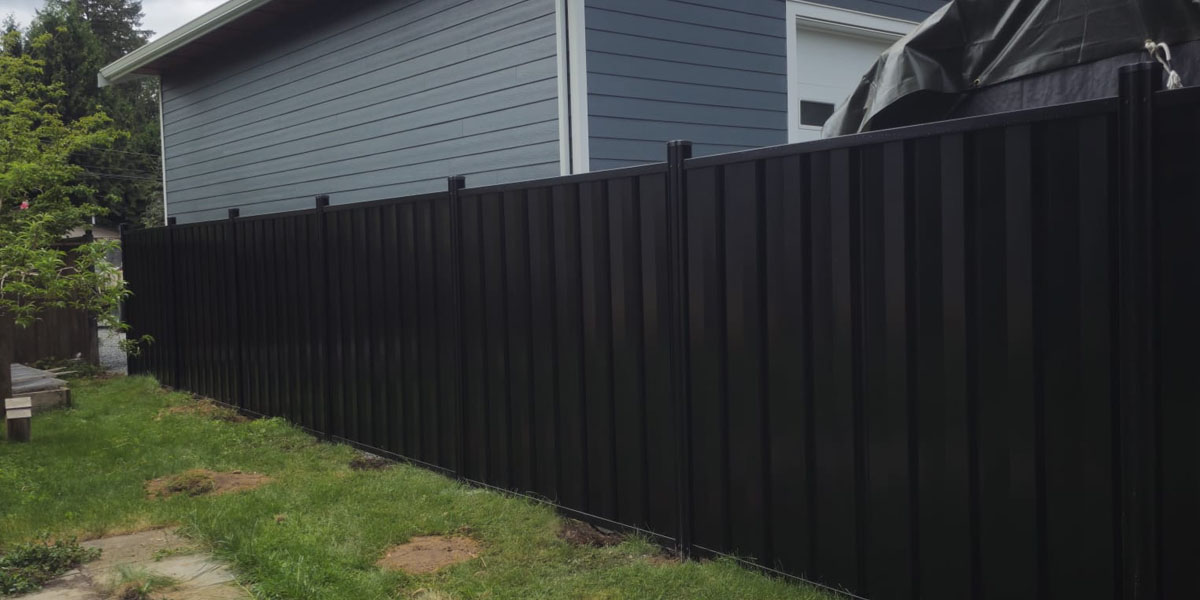
For these properties, we often recommend pairing a solid privacy fence, frequently our corrugated metal Prolink panels, with an acoustic layer where the noise source is closest and most direct. This combination addresses both the visual privacy concern that often comes with a lane-facing yard and the acoustic issue at the same time, which is a common dual priority for homeowners in this exact situation.
Scenario Three: Properties Near SkyTrain Lines
SkyTrain noise has its own distinct character that is worth addressing specifically, since it differs in important ways from road traffic. The noise is intermittent rather than constant, which means there are real moments of quiet between trains, but the noise that does occur, particularly from elevated guideways in parts of Burnaby, Surrey, and New Westminster, can be loud enough to be genuinely disruptive when it happens, especially during peak service hours when trains run frequently.
Properties near elevated SkyTrain infrastructure also deal with a noise source that is often higher up than a typical street-level barrier is designed to address, since the sound is coming from an elevated guideway rather than ground level. This means the height and positioning calculations for an effective barrier need to account for the actual elevation of the noise source, not just the horizontal distance to the property.
For homes in this situation, we conduct a more detailed site assessment than we would for straightforward street noise, specifically to understand the guideway height relative to the property and determine whether a standard fence-height barrier will meaningfully help or whether the elevation difference limits how much a ground-level fence can achieve on its own. In many cases, a well-positioned acoustic fence still delivers a worthwhile improvement, particularly for noise reflecting off nearby surfaces at ground level, even when it cannot fully address noise from height.
Scenario Four: Properties Near Rail Corridors
Freight and passenger rail lines running through parts of Burnaby, Coquitlam, Port Coquitlam, and along sections of the Fraser River present a different challenge again. Rail noise tends to be loud, lower in frequency than typical road traffic, and genuinely intermittent rather than continuous, which means the noise experience is less about constant background hum and more about distinct, disruptive events.
Lower-frequency noise is inherently more difficult for any barrier fence to fully address, since lower frequencies diffract, or bend around obstacles, more easily than higher-frequency sound. This is an honest limitation worth understanding upfront rather than discovering after installation. For rail-adjacent properties, we generally recommend the more substantial Echotrol panel system over a lighter mass-loaded barrier, since its combination of mass and internal absorption layers performs better against this specific type of lower-frequency, high-volume noise event.
It is also worth setting expectations clearly for this scenario specifically: a fence will meaningfully reduce the impact of rail noise, but homeowners in very close proximity to active rail lines should expect a more modest improvement than someone dealing with steady road traffic at a similar distance.
What These Scenarios Have in Common
Across all four of these situations, a few practical themes repeat consistently. Height and an unbroken sightline to the noise source matter more than almost any other single factor, which is why we always start an assessment by looking at the existing boundary before discussing products. The type of noise involved, steady versus intermittent, high-frequency versus low, changes which product and configuration will perform best, which is why a generic recommendation off a spec sheet is less useful than an actual site visit. And in nearly every case, a meaningful improvement is achievable even when complete silence is not, which is the realistic and honest standard we encourage homeowners to plan around.
What a Free Assessment Looks Like
When we visit a Lower Mainland property for a residential noise fence consultation, we are looking at a specific set of factors before recommending anything. We assess the current sightline between your outdoor living space and the noise source, measure the practical height options available given any local bylaw restrictions, identify the type of noise involved and whether it is steady or intermittent, and consider whether privacy is also a priority alongside noise reduction, since many of the scenarios above call for addressing both at once.
From that assessment, we recommend a specific product, either Acoustifence or Echotrol depending on your situation, at a height and configuration suited to your property, and provide a clear, honest estimate. We do not default to the same recommendation for every property, because the scenarios above genuinely call for different approaches.
Why Raybern Erectors for Residential Noise Fencing
We have been installing fencing across Vancouver and the Lower Mainland since 1964, and noise barrier fencing has become an increasingly common request as the region has grown denser and busier. Our COR-certified crews install every project to a rigorous safety standard, and every soundproof fence installation we complete is backed by a 1-year parts and labor warranty.
If your backyard backs onto a highway, a lane, a SkyTrain line, or a rail corridor anywhere in the Lower Mainland, we would be glad to walk the property with you and give you an honest assessment of what is realistically achievable.
Frequently Asked Questions (FAQs)
The difference is immediate. Once an acoustic barrier is installed at the correct height and without gaps, the noise reduction takes effect as soon as the installation is complete, with no adjustment period required.
Height restrictions vary by municipality and can differ for properties adjacent to roads, lanes, or rail corridors compared to standard residential boundaries. We can advise on applicable local requirements during your free consultation.
Mass-loaded and rigid panel acoustic systems are generally solid rather than see-through, since the density required for noise reduction also blocks visibility. If maintaining a view is important, this is worth discussing during your consultation, since it may affect height and placement decisions on your property.
While some lightweight acoustic products are marketed as DIY-friendly, achieving genuine performance depends on correct height, full coverage without gaps, and proper anchoring, all of which are easy to get wrong without experience. Professional installation ensures the barrier actually performs the way the product is capable of.
They are different rather than simply better or worse. Highway traffic is steady and constant, which barrier fencing addresses very effectively. SkyTrain noise is intermittent but can come from an elevated source, which requires a more specific assessment of guideway height relative to the property to determine the most effective approach.
Related Posts