Most homeowners start thinking about fencing bylaws only after they’ve already decided what they want to build. That’s the wrong order. A fence that’s six inches too tall in the front yard, installed without a survey confirming the property line, or built from a material prohibited in your municipality can land you with a removal order, a dispute with a neighbour, or a failed permit application that delays your entire project.
The rules across Metro Vancouver vary more than most people expect. The City of Vancouver has some of the most detailed fence regulations in the region. Burnaby, Richmond, Surrey, Port Moody, and Langley each have their own bylaws, with different height limits, different material restrictions, and different permit thresholds. Understanding the rules for your specific municipality before you call a fencing contractor is the single most practical thing you can do to keep your project on track.
This guide covers the key rules across the municipalities we serve most frequently. It is not a substitute for direct confirmation with your local building department, and bylaws do change, but it gives you a working understanding of what to expect before you begin planning.
The City of Vancouver: A Closer Look
The City of Vancouver has some of the most specific fence regulations in the Lower Mainland, and the distinction between front yards and side and rear yards is where most homeowners run into problems.
Front yard fences
In most residential zones in the City of Vancouver, a fence in the required front yard may not exceed 1.2 metres (approximately 4 feet) in height. This limit exists to preserve sightlines, support the visual character of residential streets, and allow natural surveillance of the public realm from within homes. The City takes this limit seriously, and fences that exceed it in front yards are a common source of bylaw complaints and removal orders.
The term “fence” in the City of Vancouver’s zoning bylaw is defined broadly, covering not just standard fence panels but also gates, pergolas, trellises, screens, arbors, archways, and similar structures. This means a gate at the end of your front walkway, a decorative trellis along your front property line, or a privacy screen on your front porch may all be subject to the same 1.2-metre limit.
There is a process to apply for a relaxation of the front yard height limit through a conditional development permit, but this is not a guaranteed outcome and requires the Director of Planning to assess the proposal against criteria including compatibility with the streetscape and the impact on neighbouring properties.
Side and rear yard fences
For side and rear yards in the City of Vancouver, the permitted height is generally up to 1.83 metres (approximately 6 feet). This is the height most homeowners associate with a standard privacy fence, and it is achievable without a permit in most residential zones provided no other complicating factors apply.
Retaining walls and combined heights
One of the situations that most frequently catches homeowners off guard in Vancouver is the interaction between retaining walls and fence height. Where a fence is erected on top of, or within 1.0 metre of, a common boundary retaining wall, the maximum permitted fence height is reduced by half the height of the retaining wall. In practical terms, this means a 0.9-metre retaining wall on your property line could reduce your permitted fence height by 0.45 metres, bringing a 1.83-metre fence limit down to 1.38 metres without additional approvals.
Corner lots
Corner lots in the City of Vancouver require attention to sightlines at the intersection. Height restrictions near the corner of a property exist to protect visibility for drivers, cyclists, and pedestrians. If your property is on a corner, confirm the specific requirements with the City before finalizing your fence design, as the height limits in the vicinity of the corner will differ from those along the rest of your property line.
Prohibited materials in the City of Vancouver
The City of Vancouver’s bylaw prohibits certain fence materials in residential areas. Barbed wire and razor wire are not permitted for residential fencing, and electrically charged fences are also prohibited. Any fence design incorporating these elements will not receive approval in a residential zone.
When is a permit required in the City of Vancouver?
For standard residential fences within the permitted height limits described above, a building permit is generally not required in the City of Vancouver. A permit becomes necessary when the proposed fence exceeds the height limits for its yard location, is proposed in combination with a retaining wall that affects the combined height, or involves other non-standard circumstances such as proximity to a heritage property or an environmentally sensitive area.
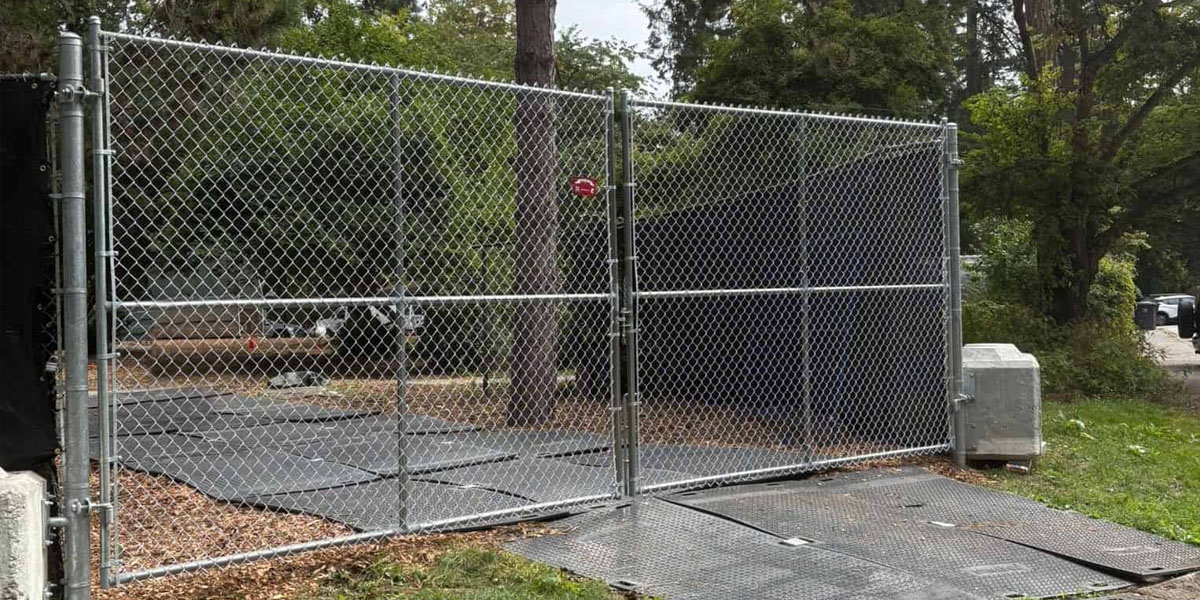
Fence Bylaws Across the Lower Mainland: Municipality by Municipality
The City of Vancouver’s rules apply only within the City of Vancouver boundary. If your property is in Burnaby, Surrey, Richmond, North Vancouver, Port Moody, Coquitlam, Langley, or any other municipality in Metro Vancouver, different bylaws apply. Here is a working overview of the key rules in the municipalities most relevant to our service area.
Burnaby
Burnaby follows a similar general pattern to Vancouver. Front yard fences are typically limited to 1.2 metres, while side and rear yard fences are permitted up to approximately 1.8 metres. Pool fencing must comply with specific BC Building Code safety requirements regardless of the general fence height limits. As with Vancouver, fences that remain within standard height limits for their yard location generally do not require a building permit in Burnaby.
Richmond
Richmond follows the same basic framework: front yard fences up to 1.2 metres, and rear and side yard fences up to 1.8 metres. Richmond’s agricultural areas and properties in or adjacent to the Agricultural Land Reserve may have additional considerations worth confirming with the City before proceeding, particularly for larger perimeter or livestock fencing projects.
Surrey
Surrey’s residential fence bylaw generally permits fences up to 1.8 metres in height in rear and side yards. A notable specific requirement in Surrey is that front yard fences in many residential zones must remain open-style rather than solid, which means chain link is generally acceptable where a solid privacy fence panel would not be. Surrey also applies the visibility triangle rule strictly on corner lots, restricting height near intersections to protect driver sightlines.
North Vancouver (City and District)
Both the City of North Vancouver and the District of North Vancouver regulate fence placement and height. Fences must be positioned on or within the property lines, and placement near property boundaries shared with neighbours is typically subject to the same general height framework as the rest of Metro Vancouver. The sloped terrain common across North Shore properties can create complications around how height is measured at different points along the fence line, which is worth clarifying with the relevant municipality for hillside or stepped lot installations.
Port Moody
As Raybern Erectors’ home municipality, Port Moody follows a broadly similar approach to fence regulation as other Lower Mainland municipalities, with front yard height restrictions and standard side and rear yard limits. The City of Port Moody is a useful starting point for confirming current requirements, and we are familiar with local expectations from six decades of working in this community.
Coquitlam and Port Coquitlam
Both Coquitlam and Port Coquitlam apply fence height regulations that align broadly with the regional pattern of lower front yard limits and higher side and rear yard allowances. As with every municipality, the specific numbers and any zone-specific exceptions should be confirmed directly with the City before proceeding.
Langley (City and Township)
Langley City and Langley Township are separate municipalities with separate bylaws, a distinction that catches some property owners off guard given how closely the two communities sit together. Agricultural properties in the Township have specific considerations around livestock fencing and farm perimeter installations that differ from standard residential fence rules. If your Langley property is on agricultural land or in the ALR, confirming requirements before starting is particularly important.
The Rules Everyone Needs to Know Regardless of Municipality
Across all of these municipalities, a few principles apply consistently enough to be worth stating plainly.
Property lines are your responsibility. Before setting a single post, you need to know exactly where your property line is. In many older neighbourhoods across the Lower Mainland, particularly pre-1970 housing stock in East Vancouver, Burnaby, and New Westminster, fences have sometimes drifted over decades and may no longer sit on the actual survey boundary. Building on the wrong side of a property line creates a dispute that can require fence relocation at your cost. A BC land surveyor can provide a survey certificate confirming your boundary, and for any installation near a shared boundary, this is a worthwhile investment.
Corner lots have additional restrictions in every municipality. Every corner lot in Metro Vancouver is subject to some form of visibility triangle restriction near the intersection that limits fence height to protect sightlines. The exact dimensions of the triangle vary by municipality, but the principle is universal. If your property is on a corner, this is one of the first things to clarify before you design your fence.
Gates are subject to the same limits as fences. In the City of Vancouver and most surrounding municipalities, a gate is legally treated as part of the fence line and must comply with the same height restrictions. A driveway gate that opens to full height above your front property line is still subject to the front yard height limit.
Pool fencing has its own requirements. Pool enclosures across BC must meet specific safety requirements under the BC Building Code, which in many cases override the general fence bylaws for that location. If your fencing project includes a pool enclosure, these requirements apply regardless of what the general fence bylaw says.
Replacing a fence in the same location is generally maintenance, not new construction. In most Metro Vancouver municipalities, replacing a fence of the same height and type in the same location is treated as maintenance and does not require a building permit. Installing a taller fence, a different material, or a fence in a new location is where permit considerations come back into play.
What a Good Fencing Contractor Will Do
Understanding the bylaw landscape before installation is part of what separates a professional fencing contractor from one who simply shows up and starts digging. At Raybern Erectors, our consultation process includes a conversation about bylaw considerations for your specific municipality and lot configuration before we recommend a fence design. We cannot act as your legal advisor or confirm permits on your behalf, but we will flag the situations that typically require closer attention, such as corner lots, front yard installations, retaining wall interactions, and agricultural properties, so you know what questions to ask your local building department before work begins.
Every installation we complete is backed by our COR-certified safety standards and a 1-year parts and labor warranty.
Contact us today for a free, no-obligation consultation and estimate.
Frequently Asked Questions (FAQs)
Yes. In the City of Vancouver and most surrounding municipalities, gates are treated as part of the fence line and must comply with the same height restrictions as the fence itself. This applies to driveway gates, pedestrian gates, and decorative entry gates in front yard locations.
No. Barbed wire and razor wire are not permitted for residential fencing in the City of Vancouver or in most residential zones across the Lower Mainland. These materials are permitted for some commercial and industrial applications, but they are explicitly restricted in residential areas.
Yes. Fences must be constructed on or within your property boundary. Where a fence sits on or near a shared boundary with a neighbour, it is advisable to confirm the property line through a BC land survey before installation, particularly on older properties where existing fence lines may not accurately reflect the legal boundary.
In rear and side yards, a fence exceeding 1.83 metres in the City of Vancouver generally requires a development permit and is not guaranteed to be approved. In front yards, a fence exceeding 1.2 metres also requires a conditional development permit. Approval in both cases depends on the Director of Planning’s assessment of the proposal against specific criteria. Over-height fences are approved in some cases, but they are not a guaranteed outcome.
Yes, significantly. Each municipality in Metro Vancouver sets its own fence bylaws, and the rules in Burnaby, Surrey, Richmond, North Vancouver, Port Moody, Coquitlam, and Langley all differ from the City of Vancouver in specific ways. The general pattern of lower front yard limits and higher side and rear yard limits is common across the region, but the exact numbers, material restrictions, and permit requirements vary. Always confirm the rules for your specific municipality before starting a fencing project.
In most residential zones in the City of Vancouver, side and rear yard fences are permitted up to approximately 1.83 metres, approximately 6 feet. Similar limits apply across most Lower Mainland municipalities, though the exact measurement and any exceptions vary by zone. A retaining wall at the property line can reduce the effective permitted fence height, so check this early if one exists on your property.
In most residential zones in the City of Vancouver, front yard fences are limited to 1.2 metres, approximately 4 feet. The same limit generally applies in Burnaby and Richmond. In Surrey, many residential zones require front yard fences to be open-style rather than solid, regardless of height. Always confirm the specific limit for your zone with your local municipality.
For a standard residential fence within the permitted height limits for its yard location, a building permit is generally not required in the City of Vancouver. A permit becomes necessary when the fence exceeds those limits, is installed on top of a retaining wall, or involves other non-standard circumstances. Confirm with the City of Vancouver’s building department for your specific project before proceeding.
Note: Bylaws change, and this article reflects publicly available bylaw information as of 2026. Always confirm current requirements directly with your local building department before beginning any fencing project. Raybern Erectors can advise on general considerations during your free consultation but cannot provide legal or permitting advice.
Raybern Erectors has been building fences across Vancouver and the Lower Mainland since 1964. Contact us today for a free, no-obligation consultation and estimate on your fencing project.
Related Posts