A garbage enclosure is not a glamorous infrastructure investment. It is also not optional for most multi-family and commercial properties in Vancouver and across the Lower Mainland. It is a code requirement, a pest control necessity, a strata bylaw obligation, and a genuine quality-of-life issue for the residents, tenants, and neighbours of any property where bins are left exposed.
And yet, across Metro Vancouver, there are strata corporations managing properties with aging enclosures that no longer meet current City of Vancouver requirements, commercial properties where bins sit exposed along lane-facing boundaries, and property managers who have never been clearly told what the actual standards are.
This guide is designed to change that. It covers what the City of Vancouver and Metro Vancouver actually require for exterior waste storage enclosures, what the most common compliance gaps are, what a properly designed and built enclosure looks like, and how to approach having one installed or replaced on your property.
What the City of Vancouver Actually Requires
The City of Vancouver’s waste management design guidelines, issued through Engineering Services and aligned with the Vancouver Municipal Code, establish specific requirements for how exterior garbage and recycling storage areas must be designed and enclosed. These requirements apply to multi-family residential buildings, commercial properties, and mixed-use developments. They are not suggestions.
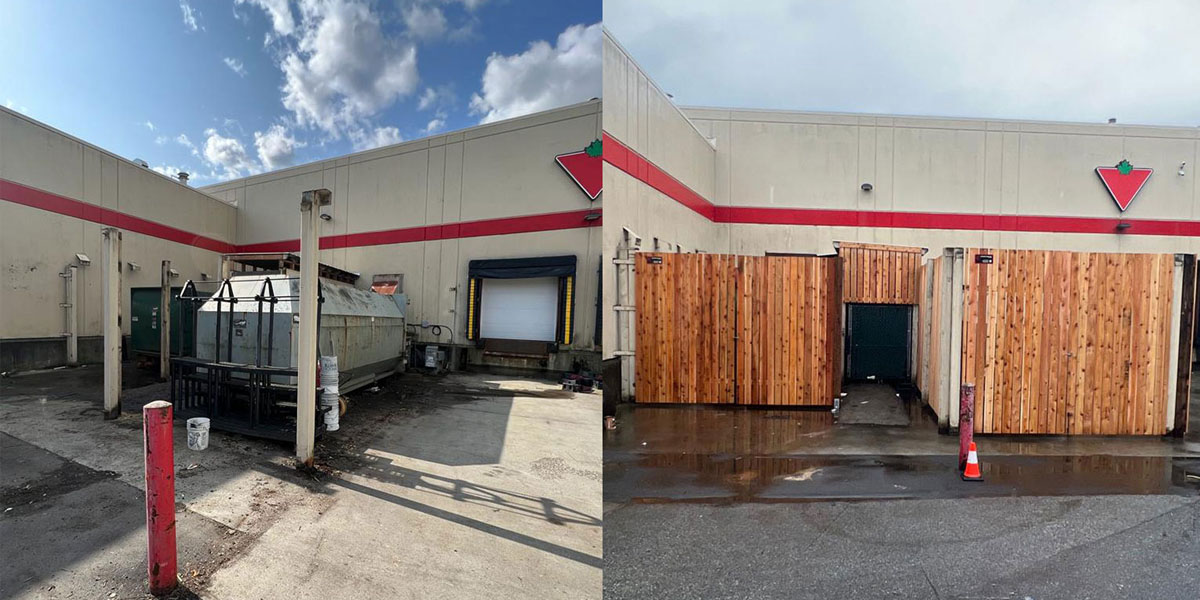
Sight-obscuring enclosure is mandatory. Exterior storage areas must be enclosed by a screen comprising a sight-obscuring wall, fence, or vegetation. This is the baseline requirement. A low barrier, partial screening, or a chain link fence without privacy treatment does not meet this standard. The enclosure must actually obscure the bins from public view.
Separate access for residents and collection vehicles is required. For multi-family tenant access, a person door, gate, or walkway separate from the service gate or door is required. Service gates for haulers must be capable of being secured in both closed and open positions of 90 degrees or greater. This means a single gate that serves both residents and collection trucks does not comply. There must be separate, designated access points for each use.
Vertical clearance for collection vehicles must be accommodated. A vertical clearance of 4.5 metres should be accommodated throughout the entire access route. Where the collection vehicle is tipping a front-end bin, 6.5 to 7.5 metres is required. For enclosed or partially covered enclosure designs, this clearance requirement constrains roof height and overhead structure in ways that many older enclosures simply do not account for.
Distance from residential units to the enclosure is regulated. The maximum distance from a residential unit to the closest garbage and recycling enclosure must be no more than 150 feet. For larger strata developments or sites with unusual layouts, this can affect where an enclosure can be placed and whether a single enclosure is sufficient or multiple locations are required.
Location must consider neighbours. Outdoor storage areas must not be located in a side or rear yard setback that abuts property not within the same development. Every effort should be made to locate outdoor garbage and recycling areas to minimize their impacts on neighbouring properties. An enclosure that creates noise, odour, or access issues for a neighbouring property can be flagged for relocation, which is a significantly more expensive problem than getting the placement right the first time.
Waste streams must be accommodated. All multi-family and commercial buildings must provide adequate space for garbage, recycling, and organic waste collection systems. Enclosures that were built when only garbage and recycling were collected often cannot accommodate the organics stream that is now mandatory across most Metro Vancouver municipalities. This is one of the most common reasons existing enclosures need to be expanded or replaced.
What Metro Vancouver’s Solid Waste Bylaws Add
Metro Vancouver’s regional solid waste bylaws operate alongside the City of Vancouver’s specific requirements. Metro Vancouver’s solid waste management bylaws require strata buildings to provide adequate garbage, recycling, and organic waste collection systems. Buildings must maintain clean, pest-free garbage rooms with proper ventilation and drainage.
The enforcement dimension is real. The City of Vancouver requires buildings to separate recyclables, organics, and garbage according to specific colour-coded systems. Failure to comply can result in collection refusal and municipal fines starting at $250 per violation.
For strata corporations specifically, this creates a maintenance and compliance obligation that sits on the strata council’s shoulders directly. An enclosure that is structurally sound but inadequately sized for the mandatory waste streams, or one that cannot accommodate the organic waste program that has expanded across the region, puts the building at risk of collection refusal and the fines that accompany it.
The Most Common Compliance Gaps
Based on the enclosure projects we see across Vancouver and the Lower Mainland, a consistent set of problems recurs across strata and commercial properties of similar vintage and type.
Enclosures that are too small for current waste streams. The introduction of mandatory organics collection has added a third bin category that older enclosures were never designed to accommodate. A two-stream enclosure built ten or fifteen years ago may be physically incapable of fitting a third organics container alongside existing garbage and recycling bins without blocking access or preventing the service gates from opening fully.
Single-gate enclosures that serve both residents and haulers. This is one of the most frequent design deficiencies we see on older Metro Vancouver strata properties. A single swing gate that residents use daily and that collection trucks use for service does not meet the current City of Vancouver requirement for separate access points. Retrofitting a pedestrian door or secondary gate into an existing enclosure is generally the most cost-effective fix for this specific gap.
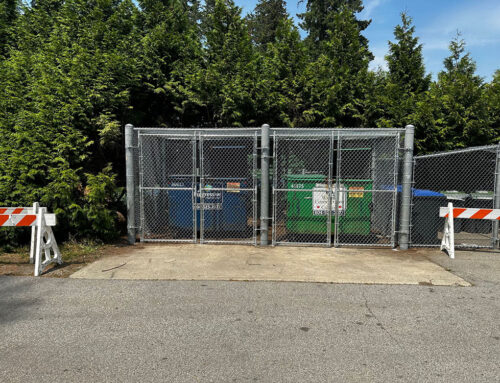
Partial screening that does not actually obscure bins. Chain link enclosures without privacy treatment, low-wall enclosures that leave the top of bins visible from the street, and wood enclosures where boards have warped or been removed all fail the sight-obscuring standard. In some cases, adding privacy slats to an existing chain link enclosure is sufficient. In others, the enclosure needs to be rebuilt to a height that provides genuine screening.
Enclosures that are structurally deteriorated. Wood enclosures in Vancouver’s climate have a limited lifespan. Ground-level rot at the base of wood posts, warped panels, failing hinges, and deteriorating hardware are all common on enclosures more than ten years old. An enclosure that is partially collapsed or cannot keep its gates closed is not providing the pest deterrence or security function that the bylaw and common sense both require.
No roof or overhead coverage where pests are a concern. The City of Vancouver’s design guidelines do not universally mandate roofed enclosures, but for properties in areas with significant pest pressure, an open-top enclosure is a less effective solution than one with at least partial overhead coverage that prevents wildlife from accessing bins from above. On properties where raccoon, rat, or bird interference with waste bins is a documented issue, this is worth discussing during the enclosure design process.
Inadequate access for large collection vehicles. Enclosures positioned in tight alleyways, with overhead obstructions, or with gates that do not open to the full 90 degrees required for service vehicles create operational problems that result in missed collections and service complaints. Getting the access geometry right requires understanding how the specific collection vehicles used by your waste hauler actually maneuver, which is a conversation worth having before an enclosure is designed rather than after.
What a Properly Designed Garbage Enclosure Looks Like
A garbage enclosure that meets current City of Vancouver requirements and serves a strata or commercial property well over the long term has a consistent set of characteristics.
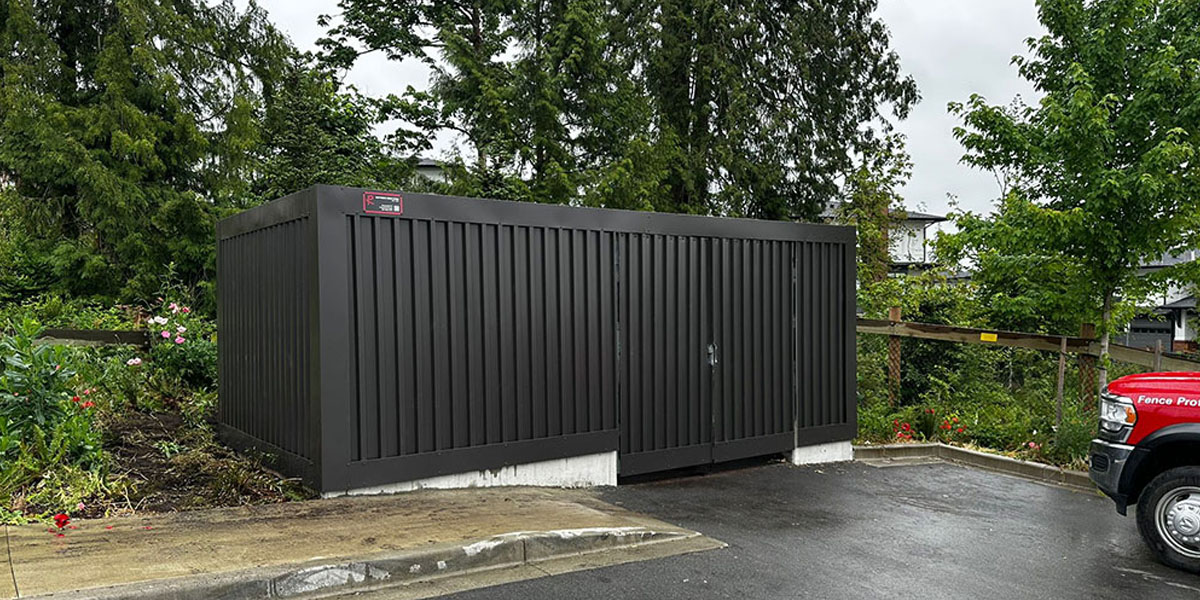
Full visual screening on all exposed sides. The enclosure material must provide complete sight obstruction, not partial screening. Corrugated metal, solid panel chain link with privacy slats, wood slat construction, or composite panel systems can all meet this standard if installed to the appropriate height. For most multi-family and commercial properties, a minimum height of approximately 1.8 metres (6 feet) is required for effective screening, though the specific height depends on the size of the containers being screened and the sightlines from adjacent properties and streets.
Separate pedestrian and service access. A properly designed enclosure has a swing or sliding gate sized for collection vehicle service, and a separate pedestrian door or gate for resident access. Both should latch securely and the service gate should be capable of being held open at 90 degrees or more during collection without requiring someone to hold it.
Dimensions appropriate for the required waste streams. The enclosure must physically fit all three waste containers (garbage, recycling, and organics) with sufficient clearance for a resident to walk between containers to deposit waste, and with the service gate opening wide enough for bins to be rolled out for collection. The City of Vancouver’s waste management guidelines provide container dimension standards that should inform the enclosure sizing.
Durable materials suited to BC’s climate. Wood enclosures are common and can be built to a reasonable standard, but they require ongoing maintenance in Vancouver’s wet climate to avoid the post rot and panel deterioration that shortens their effective lifespan. Galvanized chain link with corrugated metal panels, or a full corrugated metal enclosure using our ProGuard line, provides significantly better long-term durability with lower maintenance demands. For strata properties and commercial operators who want an enclosure that holds up for fifteen or twenty years without major intervention, metal construction is the stronger long-term choice.
Pest-resistant design. Gaps at the base of the enclosure, between panels, or around gate edges are common entry points for rats and raccoons. A properly built enclosure addresses these gaps through appropriate panel installation, ground-level sealing, and hardware that keeps gates closed securely when not in use.
Choosing the Right Enclosure Material
Corrugated Metal
Corrugated metal is increasingly the preferred material for garbage enclosures across Vancouver’s strata and commercial market, and for good reason. It is durable in BC’s climate, provides complete visual screening, resists pest interference more effectively than wood, and requires essentially no ongoing maintenance beyond periodic inspection of gate hardware. Our ProGuard line is available in custom dimensions and can accommodate single or double swing gates, pedestrian access doors, and any site-specific layout requirements.
Galvanized Chain Link with Privacy Slats
Chain link fencing with privacy slats provides a cost-effective enclosure solution where full panel construction is not required or preferred. The chain link structure provides the rigidity and security of a metal enclosure, and the slats provide the visual screening the bylaw requires. This is a popular choice for properties where budget is a primary consideration and where the aesthetic of a fully enclosed metal or wood structure is not a specific requirement.
Wood Framing with Board or Composite Panels
Wood enclosures are still widely used across Metro Vancouver strata and commercial properties, and they can be built to an attractive standard that suits properties where visual compatibility with existing structures matters. The trade-off is maintenance. In Vancouver’s climate, a wood enclosure that is not periodically inspected and treated will begin to deteriorate at the post bases and lower panel sections within five to ten years. For properties where long-term durability and low maintenance are priorities, we always recommend the metal alternative.
The Process: What to Expect When You Need a New Enclosure
Whether you are replacing a deteriorated enclosure, building one for the first time on a new property, or expanding an existing one to accommodate the organics waste stream, the process follows the same general stages.
Site assessment. The starting point is always a site visit to confirm the dimensions of the current waste area, the number and size of containers that need to be accommodated, the access requirements for both residents and collection vehicles, and the sightline considerations relative to neighbouring properties. This is also when any specific strata bylaw requirements or property manager preferences around aesthetics and materials are discussed.
Design and specification. Based on the site assessment, we produce a clear design and specification for the enclosure: dimensions, material, gate configuration, access points, and any site-specific modifications. For strata properties where a council vote or property manager approval is required before work proceeds, having a clear written specification makes that process straightforward.
Installation. Enclosure installation is typically completed in a single day for standard sizes, or two days for larger or more complex builds. Ground preparation, post setting, panel installation, and gate fitting all happen on site.
Post-installation. Before we leave the site, we walk through the completed enclosure with you to confirm the gate operation, the closure and latching of all access points, and the overall compliance with the design specification.
Every garbage enclosure installation we complete is backed by our COR-certified safety standards and a 1-year parts and labour warranty.
Why Raybern Erectors for Garbage Enclosures
Garbage enclosure installation is a small part of what we do across the Lower Mainland, but it draws on the same expertise and the same in-house fabrication capability that we bring to larger fencing and gate projects. We custom-fabricate enclosure panels and gates to the specific dimensions of your site rather than adapting a standard product that may not quite fit. Our COR-certified crews work to the same safety standard on a garbage enclosure project as on a municipal sports field installation.
We serve strata corporations, commercial property managers, restaurant and food service operators, industrial facilities, and residential developers across Vancouver, Burnaby, Surrey, Richmond, North Vancouver, the Tri-Cities, Langley, and the broader Lower Mainland.
Contact us today for a free site consultation and estimate.
Frequently Asked Questions (FAQs)
Yes. The City of Vancouver’s waste management design guidelines require that exterior garbage and recycling storage areas on multi-family and commercial properties be enclosed with a sight-obscuring wall, fence, or vegetation. This requirement applies to multi-family residential buildings, commercial properties, and mixed-use developments. Separate access for residents and collection vehicles is also required.
The City of Vancouver’s guidelines require sight-obscuring screening but do not mandate a specific material. Common compliant options include corrugated metal panels, chain link with privacy slats, wood board construction, and composite panel systems. Corrugated metal and chain link with slats are the most durable options for BC’s climate and typically require the least ongoing maintenance.
The required size depends on the number of units or the waste volume generated by the commercial operation, and the number of waste streams that must be accommodated including garbage, recycling, and organics. The City of Vancouver’s waste management guidelines provide container dimension standards that should be used to calculate the minimum required enclosure footprint. A site assessment is the most reliable way to determine the right dimensions for your specific property.
The City of Vancouver’s guidelines do not universally require roofed enclosures, but partial or full overhead coverage can be beneficial for pest management and weather protection of bins and their contents. For properties with documented pest interference, a roofed or partially covered enclosure is worth considering. Overhead clearance requirements for collection vehicles still apply.
In many cases, yes. Common retrofits include adding privacy slats to an existing chain link enclosure to meet the sight-obscuring requirement, installing a separate pedestrian gate to create the required dual-access configuration, expanding the enclosure footprint to accommodate an additional organics container, or replacing deteriorated panels and hardware while retaining the existing structural posts. A site assessment will determine whether retrofit or replacement is the more cost-effective path forward for your specific enclosure.
For standard garbage enclosure installations, a building permit is generally not required in the City of Vancouver when the enclosure meets the standard height limits for its yard location. For larger structures or those with overhead roof elements, permit requirements should be confirmed with the City before proceeding. Your contractor can advise on this during the consultation.
Corrugated metal, such as our ProGuard line, is the most durable option for Vancouver’s climate. It resists moisture, provides complete visual screening, deters pest interference more effectively than wood, and requires minimal ongoing maintenance. For strata properties that want an enclosure built once and maintained minimally over a fifteen to twenty-year lifespan, metal construction is the strongest long-term choice.
A standard garbage enclosure installation is typically completed in one to two days depending on the size, material, and complexity of the build. Custom fabrication of panels and gates may require lead time before installation can begin. Your project manager will confirm the full timeline during your free consultation.
Note: This article reflects City of Vancouver and Metro Vancouver requirements as understood in 2026. Municipal guidelines and bylaws are updated periodically. Always confirm current requirements with your local building department or waste management authority before proceeding with an enclosure installation or modification. Raybern Erectors can advise on general design considerations during your free consultation but cannot provide legal or permitting advice.
Raybern Erectors has been installing garbage enclosures, fencing, and gates for strata and commercial properties across Vancouver and the Lower Mainland since 1964. Contact us today for a free, no-obligation site consultation and estimate.