A driveway gate is not a purchase most homeowners make more than once or twice in their lifetime, which means most people are making this decision without the benefit of having done it before. That is a problem when there are several genuinely important variables to work through, each of which affects both the function of the gate and the total cost of the project.
Get the configuration wrong and you install a gate that physically cannot open on your lot. Get the automation wrong and you end up with a system that fails in the rain, which in Vancouver means a system that fails constantly. Get the material wrong and you are repainting or repairing within a few years rather than the decade or more a properly specified gate should last.
This guide is written to prevent all of that. It walks through every key decision in the driveway gate selection process for Vancouver and Lower Mainland homeowners, in the order those decisions should actually be made.
Step One: Understand Your Driveway Before You Choose a Gate
The single most important thing to do before discussing gate type, material, or automation is to understand the physical constraints of your driveway. More driveway gate projects run into problems because of site constraints that were not identified upfront than for any other reason, and the most expensive version of that problem is discovering the constraint after fabrication has begun.
How wide is your driveway opening?
Measure the actual clear opening width between your gate posts or between the edges of your driveway at the property line. This number determines the gate size you need and which configurations are mechanically feasible on your property. Standard residential driveway openings in Metro Vancouver typically range from ten feet to sixteen feet, though wider openings exist and each requires a different gate solution.
A single gate panel spanning the full opening is feasible up to a certain width before the weight and leverage of the panel create operational problems, particularly for automated systems. Beyond that width, a double gate with two panels meeting in the middle becomes the more practical and structurally sound solution.
How much space is available for the gate to travel?
This is where many homeowners make their first mistake. A swing gate needs room to arc through its opening path without hitting a vehicle, a wall, a retaining structure, or the slope of the driveway. If your driveway runs uphill from the street toward the house, a gate that swings inward will hit the rising grade before it opens fully unless the design accounts for this. If your driveway sits close to a side wall or building structure, a gate that swings in the wrong direction may not clear it.
A sliding gate needs clear linear space along the fence line equal to the full width of the gate opening plus the gate panel itself. A ten-foot opening requires approximately ten to twelve feet of clear, level fence line for the gate panel to travel into when open. If that space does not exist on your property, a sliding gate is not a viable option regardless of other preferences.
Establishing these physical realities before discussing style, material, or automation saves everyone time and prevents the expensive mistake of designing and fabricating a gate that cannot function properly on your specific site.
Step Two: Choose Your Gate Configuration
Once you understand your site constraints, you can make a genuinely informed decision about gate configuration. The four primary options for residential driveway gates are single swing, double swing, sliding, and cantilever sliding. Each suits different site conditions.
Single Swing Gate
A single swing gate is one panel hinged on one side, opening in a single arc. It is the simplest and most cost-effective configuration, and it works well for narrower openings up to approximately ten to twelve feet where the single panel weight remains manageable and the arc path is clear.
Single swing gates are the most common residential driveway gate in Vancouver, largely because most residential driveways in the city and across the Lower Mainland fall within the width range where they work well. They are straightforward to automate, require less hardware than a double configuration, and are easier to maintain over time.
The limitation is the arc path. If your driveway rises toward the gate, slopes away from it at an angle, or has obstructions within the swing radius, a single swing gate will either not open fully or require a custom design to avoid the obstruction.
Double Swing Gate
A double swing gate uses two panels, each hinged on opposite sides of the opening, meeting in the middle when closed. This configuration suits wider openings where a single panel would become too heavy or unwieldy, and it provides a symmetrical, formal appearance that many homeowners prefer on wider driveways regardless of functional necessity.
The arc path consideration applies to both panels on a double swing gate. Both sides need clear travel paths, which means a double swing gate on a driveway that slopes significantly upward from the street may need a custom design to avoid the grade interfering with either panel.
Sliding Gate
A sliding gate travels laterally along a track on the ground, moving to one side of the opening rather than swinging. It is the right choice when there is insufficient arc clearance for a swing gate in either direction, when the driveway slope makes swing operation unreliable, or when the aesthetic of a sliding gate better suits the property design.
The requirement is lateral space along the fence line. A sliding gate panel needs a clear run equal to its own width plus some travel distance to reach its fully open position. On urban Vancouver properties where the fence line runs close to a structure or a neighbouring property, confirming that this space exists before specifying a sliding gate is essential.
Cantilever Sliding Gate
A cantilever gate slides laterally like a standard sliding gate but does not use a ground track. Instead, it is suspended from posts and travels on an upper rail system. This makes it the right choice for properties with uneven or unpaved surfaces where a standard sliding gate track would be impractical, for commercial and industrial applications with heavy vehicle traffic that would damage a ground track over time, and for any site where keeping the driveway surface clear of hardware is a priority.
Cantilever gates are generally more expensive than standard sliding gates due to the more substantial post and rail hardware required to support the suspended panel weight. They are also the most reliable long-term option for sites where ground conditions would otherwise compromise a track system.
Step Three: Choose Your Gate Material
Once you know the configuration that works on your site, material selection is the next decision. This choice affects appearance, longevity, maintenance requirements, and cost, and the right answer varies depending on the fence material the gate needs to match and the environmental conditions of your specific property.
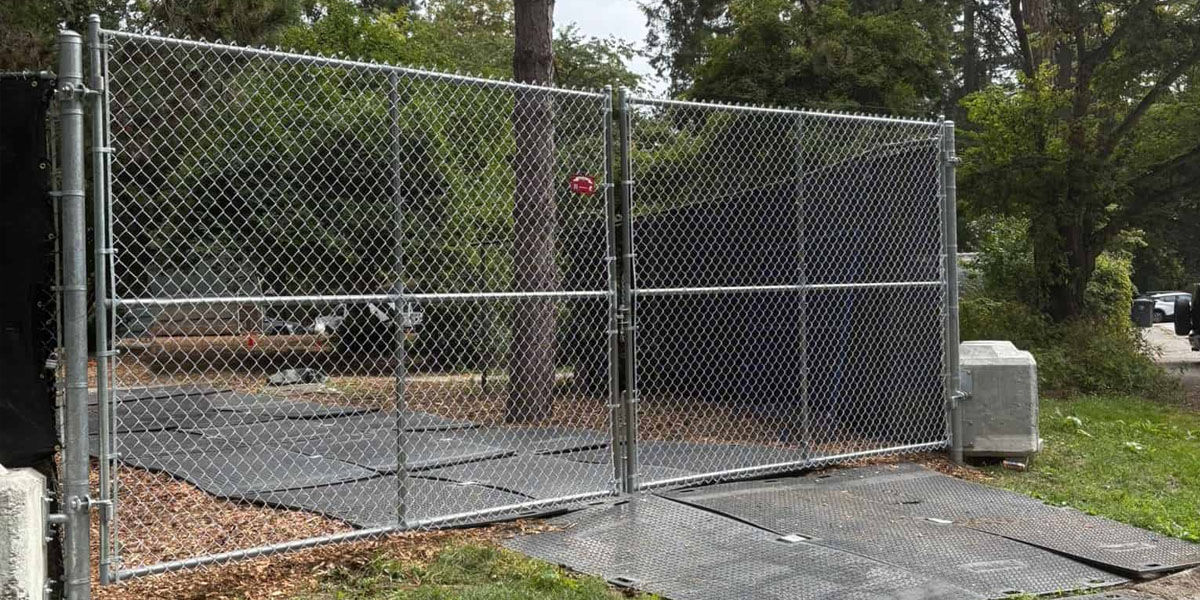
Chain Link
A chain link gate is the most common and most cost-effective option for residential properties with an existing chain link fence. Our gates are custom-fabricated in-house to match the gauge, height, and finish of your fence line, ensuring a consistent appearance rather than the visual mismatch that comes from mismatched products. A chain link gate in a vinyl-coated black finish, looks considerably more refined than standard galvanized and suits a wider range of property aesthetics.
Chain link gates are durable, low-maintenance, and work well with both manual and automated systems. They are not the right choice when the goal is a more formal or decorative appearance.
Ornamental Steel
Ornamental gates combine security with genuine visual appeal, and they are the natural choice for properties where the gate is as much a design element as a functional one. Wrought iron-style gates in powder-coated steel, picket designs, and custom scrollwork panels all fall into this category.
Our in-house fabrication shop produces custom ornamental gate designs to the specific dimensions and style requirements of your property. This matters more for gates than for almost any other fencing product, because a gate that is slightly off in height, width, or design detail is visible every day from the street. Standard catalogue ornamental gates work in some situations, but properties with non-standard openings, specific architectural characters, or matching requirements against existing ornamental fencing almost always benefit from custom fabrication.
Powder-coated finishes on ornamental steel resist corrosion well in Vancouver’s wet climate. The key maintenance requirement for ornamental gates over their lifespan is periodic inspection of the coating, particularly at welds and hardware attachment points, where coating chips can allow moisture ingress if not addressed.
Corrugated Metal (ProGuard)
For properties with existing ProGuard corrugated metal privacy fencing, the gate needs to match the panel system both aesthetically and structurally. Our Clayton Heights and Langley residential ProGuard installations both incorporated custom gates that open fully while maintaining visual continuity with the fence line, which is the right standard for any privacy fence gate regardless of the specific material.
ProGuard gates are heavier than chain link or ornamental alternatives, which affects the hardware and hinge specifications required and is one of the factors to confirm with your installer before fabrication begins.
Step Four: Manual vs. Automated
The decision between a manual gate and an automated one is often treated as binary when it is really a question of how frequently you will use the gate and what the consequences of it not working are.
Manual gates are simpler, less expensive, more reliable in the sense that there are fewer components to fail, and entirely appropriate for a gate you open once or twice a day at most. A manual gate with a quality latch and self-closing hardware is a perfectly sensible choice for many residential properties in Vancouver, particularly for pedestrian gates, side yard access, and secondary vehicle entrances.
Automated gates make sense when you use the gate multiple times daily, when getting out of the car to open a gate is genuinely impractical given your driveway layout, or when the gate serves a security function that requires controlled access rather than manual operation. They also make sense when your driveway configuration means you are frequently opening the gate in the rain, which in Vancouver is a significant practical consideration.
What automated gates require that manual gates do not is a reliable power supply to the motor, an access control interface of some kind, and a system that includes a manual override for when power is interrupted. In Vancouver, where power outages during significant weather events occur with some regularity, the manual override is not optional. It should be built into any automated system as a standard feature.
Gate motors and drive systems vary considerably in quality, weather resistance, and load rating, and the right system for a standard residential swing gate is different from what is appropriate for a heavy cantilever gate or a wide double swing installation. Your installer should be specifying the motor based on your specific gate weight, width, and usage frequency rather than applying a single default system to every project.
Access control options for automated residential gates range from simple keypads and remote controls to intercom systems, video-linked entry panels, and smart home integrations. The right level of complexity depends on your actual needs rather than the most feature-rich option available. A keypad and two remotes is appropriate for most residential applications. A full video intercom with smart home integration suits a different set of requirements and a different budget.
Step Five: Bylaw Considerations for Driveway Gates in Vancouver
Driveway gates in the City of Vancouver and across the Lower Mainland are subject to the same fence height bylaws as the fence line they are part of. In the City of Vancouver, a gate in the required front yard is subject to the same 1.2-metre height limit that applies to front yard fences in residential zones. A gate that exceeds this height in a front yard location requires the same conditional development permit process as an overheight fence.
For automated driveway gates in the City of Vancouver, the bylaw also specifies that powered gates must not interfere with pedestrian visibility and must include an emergency manual opening capability. This is consistent with what any reputable installer should be building into an automated system as standard practice, but it is worth confirming explicitly when you discuss your automation options.
Setback requirements and corner lot visibility triangle rules that apply to fences also apply to gates, since gates are treated as part of the fence line under most municipal bylaws across the Lower Mainland. If your property is on a corner or your driveway opening sits close to an intersection, confirm the sightline requirements with your local building department before finalizing your design.
For a full breakdown of fence and gate bylaws by municipality across Metro Vancouver, see our guide to Vancouver fence bylaws.
Step Six: What to Ask Your Gate Installer Before You Commit
Armed with the decisions above, these are the specific questions worth asking any gate contractor before you sign a contract.
Have you measured the arc path or slide path for the configuration you are recommending? A reputable installer will have done this before recommending a configuration, not after. If the answer is “we’ll figure that out on installation day,” that is a problem.
Is the gate fabricated in-house or sourced from a supplier? For a non-standard opening width, a specific material match to your existing fence, or any custom design requirement, in-house fabrication is what allows those specifications to be met precisely.
What is the motor specification and what load is it rated for? The motor should be specified for your specific gate weight and usage frequency, not a generic residential default.
Does the automated system include a manual override, and how does it work? This is a practical necessity in Vancouver’s climate and should be a standard feature of any system, not an add-on.
What warranty do you provide on the gate and the automation system? Parts and labour, for a defined period, in writing. See our guide to hiring a fencing contractor for more detail on what warranty terms should look like.
Have you confirmed the bylaw height limits for my specific address and yard location? A professional contractor should be able to flag whether your proposed gate design is within standard permitted heights or whether it would require additional approval.
Why Custom Fabrication Matters for Driveway Gates
The reason we emphasize in-house fabrication as much as we do throughout this guide is that a gate is the most visible and most frequently used component of any fence installation, and the tolerance for imprecision is lower than anywhere else in the project.
A gate that is two inches too wide will not close properly. A gate that is built for a level driveway but installed on a sloping one will drag. A gate that is fabricated for a standard swing radius but installed on a site with a specific obstruction will hit that obstruction every time it opens. These are not minor inconveniences. They are daily frustrations with a product that cost real money to install and should perform reliably for a decade or more.
At Raybern Erectors, every gate we install is custom-fabricated in our in-house shop to the specific dimensions, material, and configuration requirements of your site. That means your gate is built for your driveway, not adapted from a product built for someone else’s. Every gate installation is backed by our COR-certified safety standards and a 1-year parts and labour warranty.
Contact us today for a free consultation and site assessment for your driveway gate project.
Frequently Asked Questions (FAQs)
Manual gates require periodic inspection of hinges, latches, and hardware for wear and corrosion, and adjustment if the gate begins to sag or bind. Automated gates require the same hardware maintenance plus periodic inspection of the motor, drive mechanism, and access control components. Powder-coated ornamental gates benefit from inspection of the coating at welds and attachment points where chips can allow moisture ingress if left unaddressed. Chain link gates in galvanized or vinyl-coated finish require the least ongoing maintenance of any gate material.
A standard manual gate installation can typically be completed in a single day once the post and fence work is in place. Automated gate installations take longer due to the motor mounting, wiring, and access control commissioning involved. Custom-fabricated gates require a fabrication lead time before installation can begin. Your project manager will confirm the timeline during your consultation based on your specific project scope.
Gates in the City of Vancouver are subject to the same height bylaws as fences, with front yard gates limited to 1.2 metres in most residential zones. Automated gates must include a manual override capability under City of Vancouver bylaws. For most standard residential gate installations within permitted height limits, a separate building permit is generally not required. Confirm with your local building department for your specific property and zone.
In some cases, yes. Whether an existing gate can be automated depends on its weight, its structural condition, the hinge and post specifications, and whether there is a viable power supply accessible at the gate location. An on-site assessment is the most reliable way to determine whether your existing gate is a good candidate for automation or whether a new gate would be the more practical and cost-effective starting point.
A basic manual residential swing gate installation typically is the baseline for a standard single swing chain link or ornamental gate. Double swing gates, wider openings, heavier materials, and automation systems all add to the base cost. Automated systems add the cost of the motor, access control hardware, and installation labour for the electrical components. Custom ornamental fabrication is quoted specifically based on the design and dimensions involved.
The single swing gate is the most common configuration for residential properties across Metro Vancouver, largely because most standard residential driveways fall within the width range where a single panel works well and the arc clearance is manageable. Double swing gates suit wider openings and more formal property aesthetics. Sliding and cantilever gates are the right choice when arc clearance is not available.
Raybern Erectors has been designing and installing custom gates across Vancouver and the Lower Mainland since 1964. Contact us today for a free, no-obligation site consultation and estimate on your driveway gate project.
Related Posts