Chain link fencing is the most straightforward conversation in the fencing industry to start, and often the most complicated one to finish. The starting price is low. The range is wide. And the gap between a rough estimate and the actual quote on your specific project can be significant if you do not understand what is driving the difference.
This guide is written for Vancouver and Lower Mainland property owners who want an honest picture of what chain link fence installation actually costs in BC before they pick up the phone. We cover per-foot pricing by height and gauge, the cost impact of gate additions, terrain challenges, and commercial versus residential specifications. At the end, we will tell you what we genuinely cannot quote without seeing your site, and why.
What Chain Link Fence Installation Costs in Vancouver: The Starting Range
Based on current market pricing across Metro Vancouver in 2026, professional chain link fence installation in BC typically runs in the range of $26 to $40 per linear foot for a standard residential installation. This is an all-in figure covering materials and labour for a straightforward installation on reasonably level, accessible ground with no significant complicating factors.
For context, that puts a typical 100-foot residential chain link fence somewhere between $2,600 and $4,000 installed, before gates or any specification upgrades. A 150-foot installation runs roughly $3,900 to $6,000 under the same conditions.
These numbers reflect BC’s cost environment, which runs slightly higher than national Canadian averages due to labour rates and material costs in the Lower Mainland. They are also professional installation figures. DIY material costs are substantially lower, but the trade-off in post-setting precision, tensioning, gate alignment, and long-term structural performance is real and worth accounting for.
A few things to understand about these numbers before going further. They represent a realistic mid-market range for standard residential work, not the cheapest possible quote or the most expensive one. They assume reasonable access, level or gently sloped terrain, and a standard height residential installation. Every factor discussed below has the potential to move your specific project higher or lower within and beyond this range.
The Biggest Cost Driver: Height
Fence height is the single largest variable in chain link installation pricing, because it affects both the amount of material required and the labour involved in a compounding way.
A 4-foot chain link fence, which is the standard permitted height for front yard fencing in Vancouver and most Lower Mainland municipalities, uses significantly less fabric and lighter post specifications than a 6-foot fence. A 6-foot fence uses less than an 8-foot fence, which requires heavier gauge posts, deeper concrete setting, and more labour than the residential standards below it.
As a practical guide to how height affects pricing in the Vancouver market:
4-foot fence sits at the lower end of the installed price range. This is the most common specification for front yards, trail markers, light pet containment, and property line definition where privacy and security are not the primary goals. Material requirements are lower and installation is faster than taller specifications.
6-foot fence is the most common residential specification for side and rear yards, where security and boundary definition are the primary objectives. This is the height most homeowners default to for backyard installations and is the standard against which mid-range pricing is typically quoted.
8-foot fence moves into commercial and high-security territory. Post specifications, concrete depth requirements, and material weights all increase at this height. Pricing reflects that additional structural demand.
Heights above 8 feet, which are common for commercial, industrial, and high-security installations, move further beyond standard residential pricing and should be quoted specifically based on your site and security requirements.
Gauge: What It Means and Why It Matters for Cost
Gauge refers to the thickness of the wire used to weave the chain link fabric, and it is one of the most consequential specification decisions in a chain link fence project, both for performance and for price.
The gauge numbering system runs counter-intuitively: a lower gauge number means thicker, heavier wire. An 11-gauge wire is thicker and stronger than a 13-gauge wire. This matters because the two most common residential gauges in BC, 11-gauge and 11.5-gauge, perform meaningfully differently from the lighter 13-gauge wire sometimes used in basic residential applications, and heavy-duty commercial specifications at 9-gauge or lower perform differently again.
For most residential applications in Vancouver, 11.5 or 11-gauge galvanized wire strikes the right balance between durability and cost. It is strong enough to withstand casual impact, resist sagging over time, and hold its shape through BC’s seasonal changes without the additional cost of heavier commercial-grade material.
For applications where the fence will face regular impact, contain large or determined animals, serve a commercial facility, or need to deter unauthorized access, moving to a heavier gauge is worth the additional material cost. The per-foot price difference between a standard residential gauge and a commercial-grade specification is meaningful at scale, but the performance difference over the life of the fence is more significant still.
The practical point is that if you are quoted two prices for what sounds like the same fence, gauge is one of the first things to check. A cheaper quote may be using lighter wire that will not perform as well or last as long in your specific application.
Galvanized vs. Black Finish: Understanding Your Coating Options
Standard chain link fencing uses galvanized steel wire, which is the base product, the most widely used option, and the most cost-effective choice for the vast majority of residential and commercial applications across the Lower Mainland. Galvanized wire provides strong corrosion resistance in BC’s wet climate and is the appropriate specification for most projects.
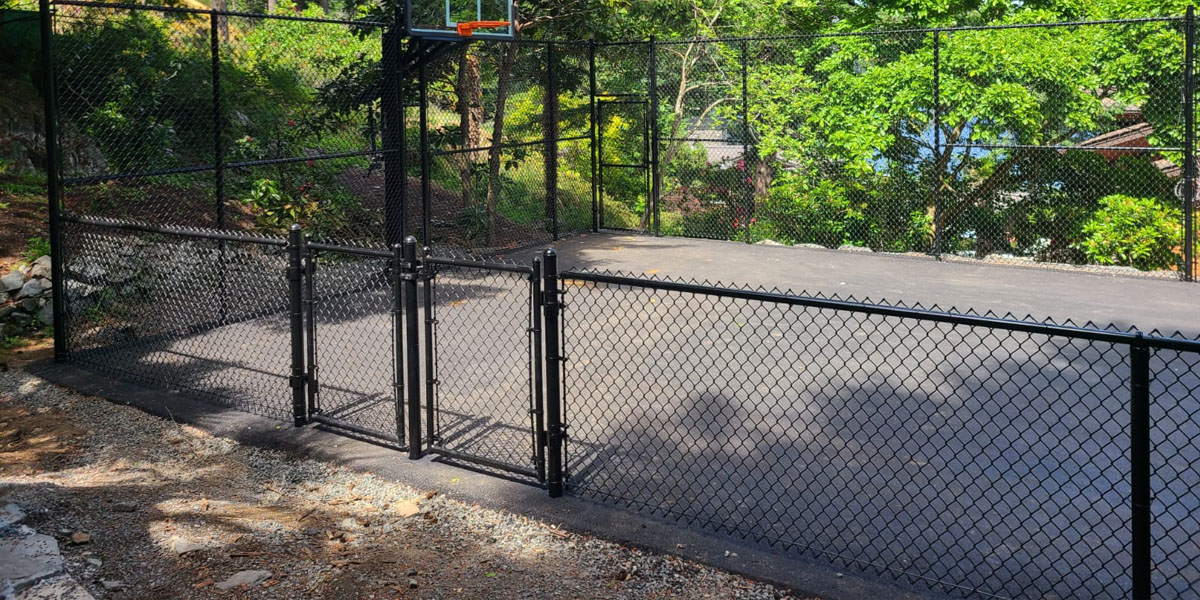
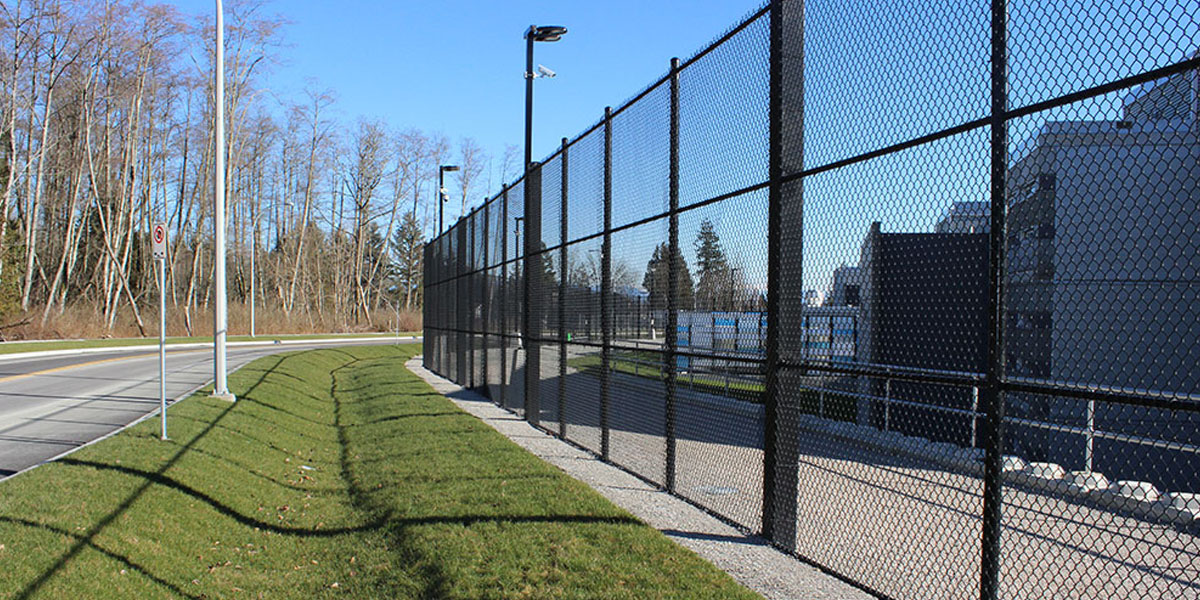
For property owners who have an aesthetic preference for black chain link, or whose project is in a coastal or high-moisture environment where an additional protective layer makes practical sense, vinyl-coated chain link in black is available at an upcharge relative to standard galvanized. The additional cost typically runs in the range of $3 to $5 per linear foot for the material difference. For most inland and suburban residential applications across Vancouver, Burnaby, Surrey, Coquitlam, and Langley, standard galvanized chain link performs extremely well and does not require the coating upgrade.
The default for most Raybern Erectors installations is galvanized chain link, and for the large majority of our clients that is the right call both on performance and on cost.
Privacy Slats: Adding Visual Screening to Chain Link
Privacy slats are woven through the chain link mesh to add visual screening without replacing the fence structure. They are a popular add-on for residential chain link installations where some additional privacy is desired but a full privacy fence product is not necessary or not within budget.
The installed cost of adding privacy slats to a new chain link fence varies depending on the slat material, the height of the fence, and whether they are being installed at the same time as the fence or retrofitted to an existing installation. Slats installed concurrently with a new fence are generally more cost-efficient since the crew is already on site and the fabric tensioning has not yet been finalized.
If full visual privacy is the primary goal rather than partial screening, it is worth having a conversation about dedicated privacy fencing options during your consultation. Our corrugated metal Prolink line provides complete visual coverage with greater durability than chain link with slats and may be the more appropriate product depending on your priorities.
Gates: The Variable That Most Affects Your Total
Gates are where chain link fence projects most commonly come in higher than initial expectations, and it is worth understanding why before you budget.
A basic single swing gate, typically four feet wide for pedestrian access, adds a meaningful fixed cost to any installation that has nothing to do with the per-foot price of the fence line itself. This is because gates require heavier post specifications, additional hardware, hinges rated for the gate weight, latches, and fitting and levelling work that is separate from running a fence line.
In the Vancouver market, typical gate costs for residential chain link installations run approximately as follows. A standard single swing pedestrian gate adds somewhere in the range of $400 to $700 depending on height, width, and hardware specification. A double swing driveway gate covering a standard residential driveway width adds more, typically in the range of $800 to $1,500 or more depending on width, height, and the hardware required.
Automated gates are a separate category entirely and are quoted individually based on the automation system, the gate weight and width, and the access control requirements of the specific installation.
The practical point is that a project with multiple gates will look meaningfully different from a per-foot estimate once gates are added. Always clarify gate specifications in your initial conversation with your fencing contractor so the quote reflects your actual project scope rather than just the fence line.
Terrain, Access, and Site Conditions
The per-foot pricing ranges above assume reasonably level ground and reasonable equipment access. When those conditions do not apply, additional costs reflect the additional labour and time involved.
Sloped terrain is one of the most common site challenges across the Lower Mainland, given the hillside topography of many neighbourhoods in North Vancouver, Burnaby Mountain, Port Moody, and throughout the Tri-Cities. A fence following a slope requires either a racked installation that follows the grade continuously or a stepped installation with flat sections and gaps at the bottom between posts. Both approaches require additional planning and fitting work compared to a flat-ground installation.
Rocky ground increases post-setting time and may require drilling rather than standard post driving, adding cost that is typically quoted as a per-post surcharge rather than a per-foot addition.
Limited access to tight side yards, lane-facing boundaries, or fenced back properties where equipment cannot be brought in adds labour time. When material has to be carried rather than driven to the installation point, that time is real and reflected in the quote.
Removal of existing fencing adds cost that many homeowners do not initially factor into their budget. Removing and disposing of an existing wood, chain link, or other fence before installing a new one typically adds a per-foot removal charge to the overall project cost.
Residential vs. Commercial Chain Link: Why Specifications Differ
A commercial chain link fence and a residential chain link fence may look similar from the street but differ meaningfully in their specifications, and those differences are reflected in cost.
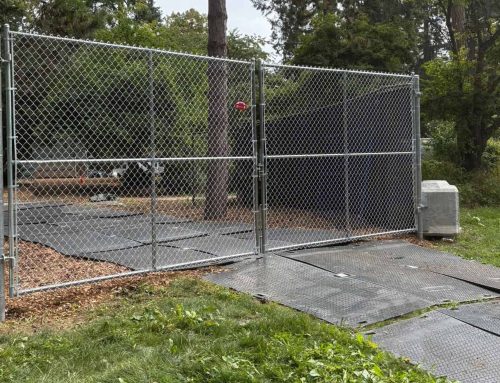
Commercial installations, particularly those involving industrial yards, transportation facilities, and high-security perimeters like our installation for Tenold Transportation in Abbotsford, typically use heavier gauge wire, larger post diameters, additional post bracing, concrete specifications designed for heavier loads, and top rails and tension wire specified for longer runs under greater load. Barbed wire or razor wire topping is common on commercial and industrial perimeters and adds both material and safety-related labour cost.
The per-foot cost for a commercial chain link installation reflects all of these specification differences and will be meaningfully higher than a residential quote for an equivalent linear footage. If you are requesting quotes for a commercial or industrial project, make sure the specification is clearly defined upfront so you are comparing equivalent products.
What We Cannot Quote Without Seeing Your Site
The pricing information in this article is intended to give you a realistic planning range before you request a quote. It is not a substitute for an on-site assessment, and there are genuinely important factors that cannot be accounted for without a site visit.
We cannot know the precise linear footage of your installation until we measure it. We cannot know the soil conditions at your specific property, the access challenges particular to your lot, or the complicating factors that only become visible when someone actually walks the site. We cannot determine whether your project has any specific municipal bylaw considerations without knowing your exact address and zone.
What we can do is provide a free on-site consultation that turns a planning range into an actual quote, specific to your property, your specification, and your project scope.
Every chain link installation we complete in Vancouver and across the Lower Mainland is backed by our COR-certified safety standards and a 1-year parts and labor warranty.
Frequently Asked Questions (FAQs)
For a standard residential chain link fence within the permitted height limits for its yard location, a building permit is generally not required in the City of Vancouver. Height limits vary by yard location, front versus side and rear, and by municipality. See our guide to Vancouver fence bylaws for a full breakdown by municipality.
Yes. Chain link is generally the most cost-effective fencing option in terms of installed price per linear foot among standard fencing materials. It also carries lower long-term maintenance costs than wood, which requires regular treatment to perform in BC’s wet climate.
Yes. Sloped terrain adds labour time and complexity to any fence installation. The specific impact depends on the degree of slope, the length of the run, and whether a racked or stepped installation is the appropriate solution for your site. This is one of the factors that requires an on-site assessment to price accurately.
A standard single swing pedestrian gate typically adds approximately $400 to $700 to a residential chain link project. A double swing driveway gate adds more, generally in the range of $800 to $1,500 or higher depending on width, height, and hardware. Automated gates are quoted individually.
Yes. Galvanized chain link is specifically engineered for outdoor use in demanding weather conditions and performs well across the full range of Metro Vancouver’s climate. For properties in coastal locations with direct salt air exposure, a protective coating may extend longevity further, but for the vast majority of Lower Mainland residential and commercial applications, standard galvanized chain link is the appropriate and most cost-effective specification.
For most residential applications in the Lower Mainland, 11 or 11.5-gauge galvanized wire is the right choice. It provides strong performance and longevity without the additional cost of heavy commercial-grade specifications. For commercial, industrial, or high-security applications, heavier gauges at 9-gauge or below are more appropriate and should be quoted specifically based on your requirements.
Yes. Height is the single largest variable in chain link pricing after linear footage. A 4-foot fence sits at the lower end of the pricing range. A 6-foot fence is the most common mid-range residential specification. Fences at 8 feet and above move into heavier post and concrete specifications that push pricing meaningfully higher.
In Metro Vancouver in 2026, professional chain link fence installation typically runs in the range of $26 to $40 per linear foot for a standard residential installation on level, accessible ground. Commercial and high-security specifications run higher depending on gauge, height, and post requirements.
Raybern Erectors has been installing chain link fencing across Vancouver and the Lower Mainland since 1964. Contact us today for a free on-site assessment and an accurate quote for your specific project.
Related Posts