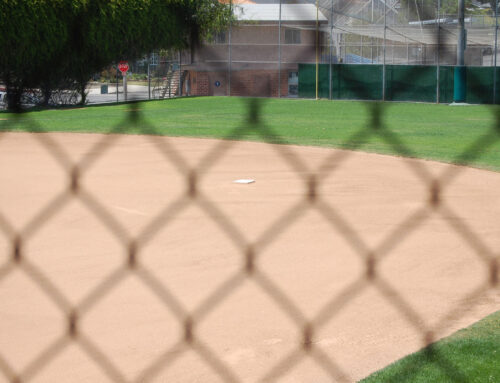
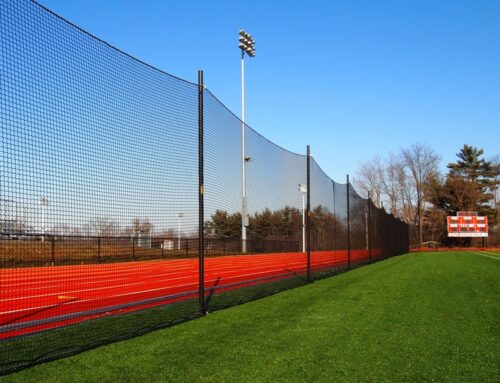
Most athletic netting projects are reasonably straightforward. A baseball diamond needs a backstop. A driving range needs a containment net at a known height and span. A soccer field needs end zone netting behind the goals. For these standard applications, a contractor with the right materials and a reasonable level of experience can deliver a solution that works.
Then there are the other facilities. The ones with an irregular property line, a heritage building close to the field of play, a multi-sport space that needs to serve three different activities depending on the day, or a site with grade changes and structural obstacles that no standard netting catalogue was ever designed around. These are the projects where custom athletic netting stops being a nice-to-have and becomes the only way to get the job done properly.
This guide is about that second category. If you manage a facility that does not fit a standard template, here is what you need to know about custom netting, custom rope nets, and how a properly engineered system gets built around a site rather than the other way around.
What Makes a Facility “Non-Standard”
Before getting into solutions, it is worth being specific about what actually makes a site non-standard, because the term covers a wider range of situations than most facility managers initially assume.
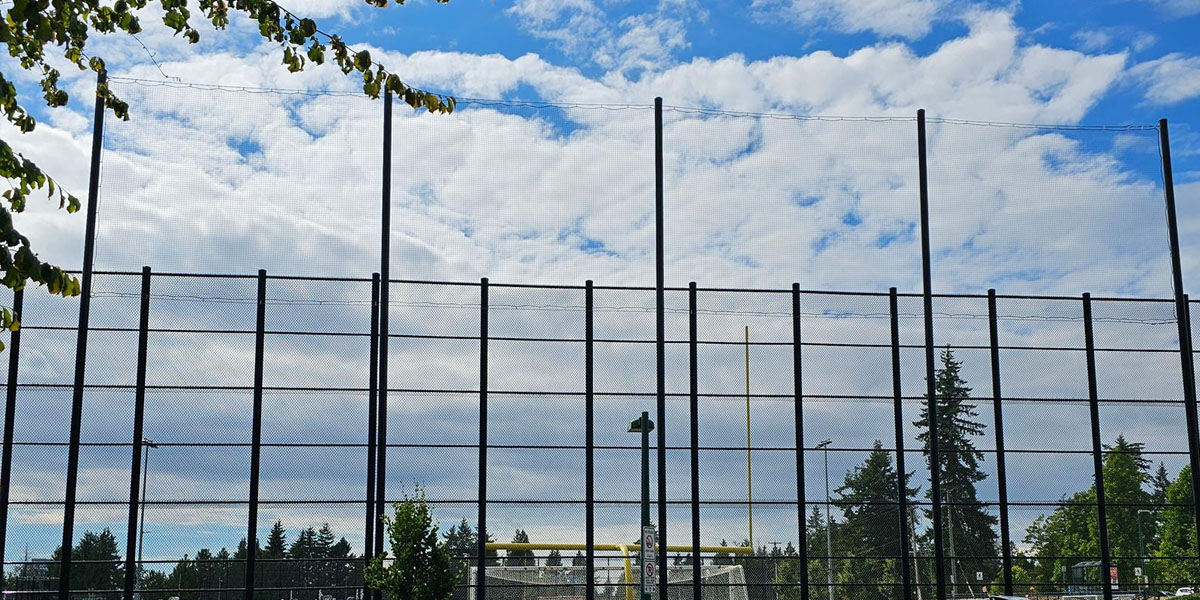
Irregular property boundaries. Urban and suburban sites, particularly in built-up areas of Vancouver, Burnaby, and Surrey, often have to fit a sports facility into a lot shape that was never designed with that use in mind. A standard rectangular netting run does not always make sense when the boundary itself is not rectangular.
Proximity to structures, roads, or other facilities. A field that backs onto a parking lot, a busy road, a school building, or another sports facility entirely needs netting that accounts for that adjacency specifically, not a generic containment system sized for an open field with nothing nearby.
Significant grade changes. Flat sites are the exception rather than the rule in much of BC. Sloped terrain affects post heights, anchoring methods, and how netting needs to be tensioned to maintain consistent containment across the full span of an uneven site.
Multi-sport or shared-use facilities. A field or court that serves more than one sport, or that needs to convert between configurations depending on the season or event, often requires netting systems that can be adjusted, removed, or reconfigured rather than a single fixed installation.
Unusual height or span requirements. Some applications genuinely exceed what standard netting products are built for. Driving ranges are the most obvious example, but indoor facilities with high ceilings, specialty training environments, and large-format multi-bay setups can all push beyond standard specifications.
If any of this sounds like your facility, you are exactly the audience this guide is written for.
Why Standard Netting Falls Short on These Sites
Standard, off-the-shelf netting products are manufactured to common specifications because that is what makes them affordable and readily available. The trade-off is that they are built for the average case, not your specific case.
On a non-standard site, this creates real problems. A standard panel height might be too short to account for a slope that drops away behind the field. A standard mesh aperture might be wrong for the specific ball size and velocity involved in your sport. A standard anchoring system might not work on a site with structural obstacles below grade or insufficient clearance for ground sleeves. And a standard installation almost never accounts for a facility’s specific need to be reconfigured seasonally or removed entirely for part of the year.
When a contractor tries to force a standard product onto a non-standard site, the result is usually one of two outcomes. Either the installation does not actually solve the problem it was meant to solve, leaving gaps in coverage or inadequate height where the site’s specific challenges were never properly addressed, or it requires expensive and time-consuming modifications on-site that a custom design would have anticipated from the start.
What Custom Athletic Netting Actually Involves
At Raybern Erectors, we approach every non-standard facility the same way: by starting with the site, not with a catalogue. Custom athletic netting means the dimensions, the mesh specification, the post and anchoring system, and the configuration are all determined by your specific property rather than selected from a limited set of pre-built options.
Site assessment first. Before recommending any netting solution, we walk the property, document the boundary, identify grade changes, note nearby structures, and understand exactly how the space is used. This step is what separates a genuinely custom installation from a standard product with a few adjustments bolted on.
Custom rope nets and mesh configurations. For facilities with unusual containment requirements, whether that is a specific ball size, an unusual span, or a need for netting that performs differently in different sections of the same installation, we design and source rope net and mesh configurations matched to those exact specifications rather than relying on a single standard product across the whole site.
Engineered support structures. Post height, spacing, and anchoring method are all calculated based on the specific load, wind exposure, and ground conditions of your site. On sloped terrain, this often means varying post heights along the run to maintain a consistent net plane even as the ground itself changes elevation.
Modular and reconfigurable systems. For multi-sport and seasonal facilities, we design netting systems with removable panels, adjustable tensioning, or modular sections that allow the facility to be reconfigured for different uses without a full reinstallation each time.
Integration with existing structures. Many non-standard sites need netting that ties into existing fencing, buildings, or other infrastructure rather than standing entirely independent. We design these connection points specifically rather than treating the netting as a standalone system that happens to be near other structures.
Real Applications We Have Solved
Custom netting work tends to be more concrete when grounded in specific examples rather than abstract categories, so here are a few of the situations we have engineered solutions for across BC.
Driving ranges requiring extreme heights. Golf driving range netting is one of the most demanding standard applications that almost always requires custom engineering in practice. Heights exceeding 100 feet, sustained wind loading, and continuous high-velocity impact all require a tensioning and support system well beyond what a typical backyard or recreational netting product is built to handle. Our installation at Mayfair Lakes Golf and Country Club in Richmond reflects this level of engineering.
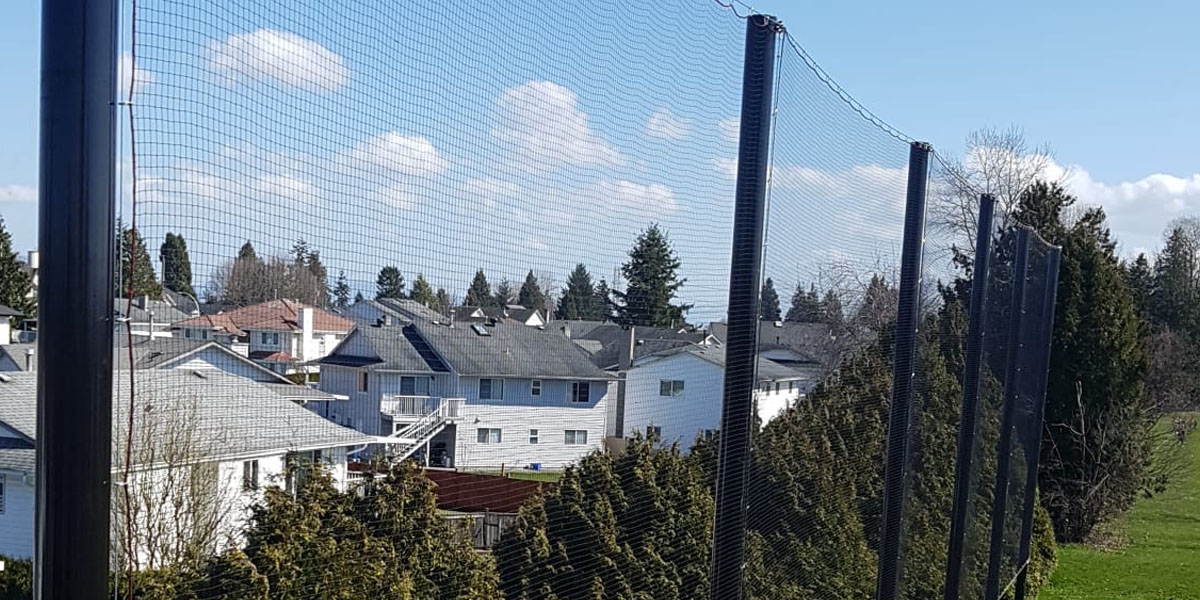
Urban fields with tight boundaries. Sites in dense parts of Vancouver and Burnaby sometimes require netting configurations that hug irregular property lines closely, maximizing usable field space while still providing full containment along boundaries that are anything but a simple rectangle.
Multi-use community facilities. Municipal parks departments frequently need netting systems that serve baseball in the spring and summer and a different configuration, or no netting at all, for other uses during the rest of the year. We have designed systems specifically to accommodate this kind of seasonal flexibility.
Sites with structural obstacles. Properties with utility infrastructure, unstable soil in specific areas, or limited excavation clearance for ground sleeves require alternative anchoring approaches, including surface-mounted base systems or wall-integrated mounting where ground anchoring is not practical.
Materials That Matter for Custom Installations
The same UV-resistant, high-tensile mesh materials that perform well in standard applications form the foundation of every custom system we build, but the engineering decisions around how those materials are deployed change significantly from site to site.
For non-standard sites, we typically work with galvanized or powder-coated steel posts sized specifically for the load and height requirements of the installation, high-tensile cable tensioning systems for large-span or variable-height configurations, custom mesh apertures matched to the specific ball size and velocity involved, and a choice of ground sleeve, surface-mounted, or wall-integrated anchoring depending on what the site’s structural conditions actually allow.
The goal is always the same regardless of how the specific configuration ends up looking: a system engineered specifically for your site’s real conditions rather than adapted from a product built for somewhere else.
Who Needs Custom Athletic Netting
Custom netting solutions tend to be most relevant for a specific set of clients across BC, though the underlying need, a site that does not fit a standard template, can show up anywhere.
Municipal parks and recreation departments managing older facilities with constrained or irregular lot shapes are frequent clients, as are school boards working with sites that were never purpose-built for athletics and now need to retrofit safe containment systems around existing buildings and infrastructure. Golf course and driving range operators almost always require custom engineering given the heights and loads involved. Landscape architects and general contractors managing new multi-sport facility builds often bring us in specifically because the brief calls for flexibility that a standard product cannot deliver. And sports clubs and athletic associations operating in leased or shared facilities frequently need modular systems that can be installed, adjusted, and removed without disrupting the underlying property.
Why Raybern Erectors for Custom Netting in BC
Custom athletic netting is not a service every netting contractor in the Lower Mainland genuinely offers, even when it appears on their list of capabilities. Designing a system around a non-standard site requires the in-house fabrication capability to produce something other than a standard catalogue product, and it requires the structural and engineering knowledge to do that safely and durably.
At Raybern Erectors, we bring over 60 years of structural installation experience to every custom netting project, along with the in-house fabrication shop and supplier relationships needed to source and build custom rope nets and mesh systems specific to your site. Our COR-certified crews handle every installation under rigorous safety standards, and every project is backed by a 1-year parts and labor warranty.
If your facility has been told no by a netting contractor before, or if you have simply never found a standard solution that actually fits your site, we would welcome the conversation.
Recent Sports Field Netting Projects
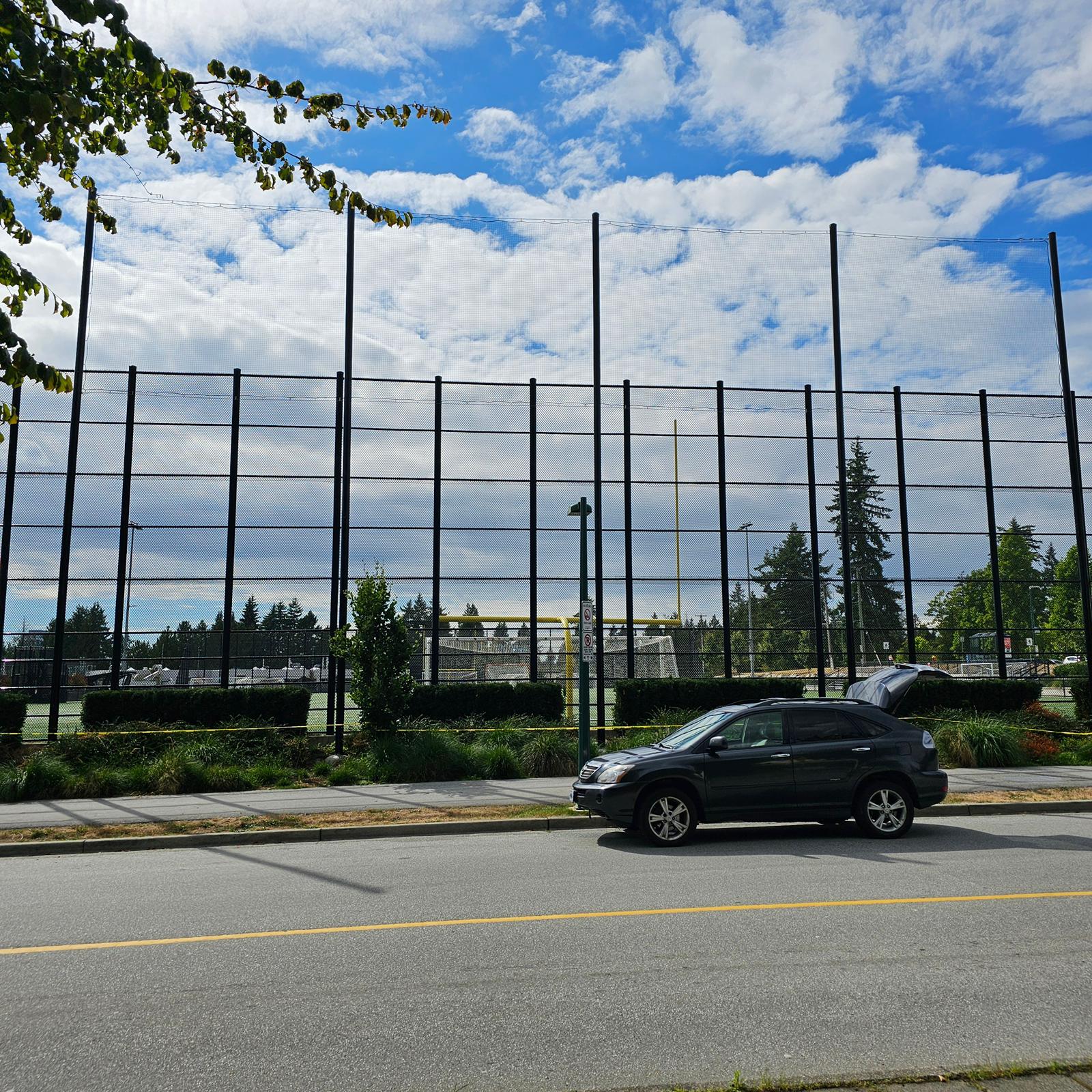


Frequently Asked Questions (FAQs)
Yes. We regularly work with municipal parks departments, school boards, and landscape architects on facilities that require custom engineering, and we are experienced navigating the procurement and compliance requirements that come with public sector projects.
Yes. For multi-sport and seasonal facilities, we design modular systems with removable panels or adjustable tensioning that allow reconfiguration without a full reinstallation each time the facility’s use changes.
It depends on the complexity of the site. In some cases, a properly engineered custom system actually costs less than forcing a standard product to work through expensive on-site modifications. A free site assessment is the best way to get an accurate comparison for your specific facility.
Yes. Mesh aperture size can be specified to match the exact ball size and velocity involved in your sport, which matters for facilities serving sports outside the standard baseball, soccer, or golf categories most netting products are designed around.
Custom netting is designed around your specific site conditions, including boundary shape, grade changes, nearby structures, and sport-specific containment needs, rather than selected from a fixed set of standard product configurations. The dimensions, mesh specification, and support structure are all determined by an on-site assessment rather than a catalogue.
Related Posts