If you have spent any time researching fencing options for a rural property, an acreage, or even a garden boundary in British Columbia, chances are you have come across split rail fencing. It is one of the oldest fence styles in North America, and it remains one of the most popular choices for BC property owners who want a boundary that looks like it’s part of the land rather than something installed on top of it.
But split rail fencing means different things to different people, and the details matter. What exactly is a split rail fence? Where does it work best, and where does it fall short? What does it actually cost in BC, and how long can you expect it to last? This guide answers all of that, drawing on what we have learned installing cedar split rail fences across the Lower Mainland and BC for over 60 years.
Why Cedar Is the Material of Choice
While split rail fencing can technically be built from a few different wood species, Western Red Cedar has become the standard choice across BC for good reason. Cedar contains natural oils and tannins that give it inherent resistance to rot, decay, and insect damage without requiring any chemical treatment. In a province where rainfall is a defining feature of the climate for much of the year, that natural resistance is not a minor detail. It is the single biggest reason cedar split rail fences hold up as well as they do.
Untreated softwoods like standard pine or fir will begin to break down far faster when exposed to BC’s wet conditions. Pressure-treated alternatives can close that gap somewhat, but they introduce chemical treatments that some property owners specifically want to avoid, particularly on agricultural land, near livestock, or in environmentally sensitive areas. Cedar achieves comparable or better durability without any of that.
The other advantage is purely aesthetic. Cedar ages into a soft silver-grey patina over time if left untreated, which most property owners find complements a natural landscape far better than a fence that requires regular staining to maintain its colour.
Where Split Rail Fencing Works Best
Split rail fencing is not the right choice for every property, and understanding where it genuinely excels will save you time and help you avoid a mismatch between expectations and reality.
Acreage and rural properties. This is the classic application, and for good reason. Split rail fencing is cost-effective over long distances, which matters when you are fencing a large property rather than a typical residential lot. Across Langley Township, Maple Ridge, Mission, and the broader Fraser Valley, we regularly install split rail fencing for exactly this purpose: marking the boundary of a larger property without the cost of a solid fence running the full perimeter.
Equestrian properties and paddocks. Horse properties have used post and rail style fencing for generations because it is visually appropriate, safe for animals, and clearly defines space without obstructing a horse’s line of sight, which actually reduces the risk of spooking compared to a solid barrier. Split rail on its own is generally not sufficient to contain horses securely, which is an important point we will return to below, but as a visual perimeter paired with appropriate containment wire, it remains the standard for a reason.
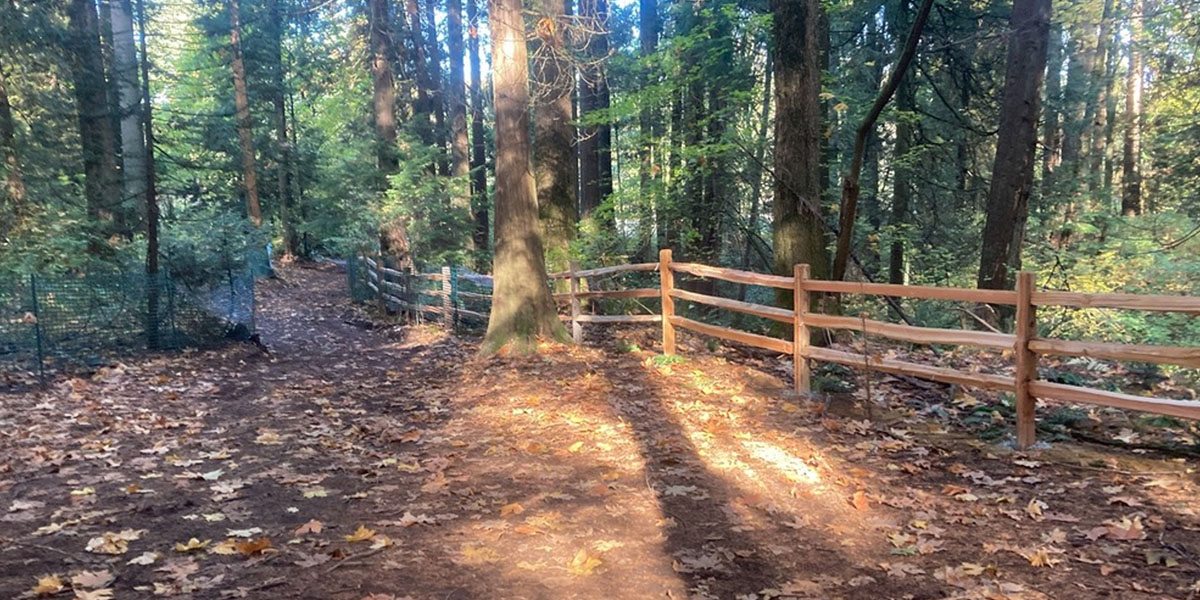
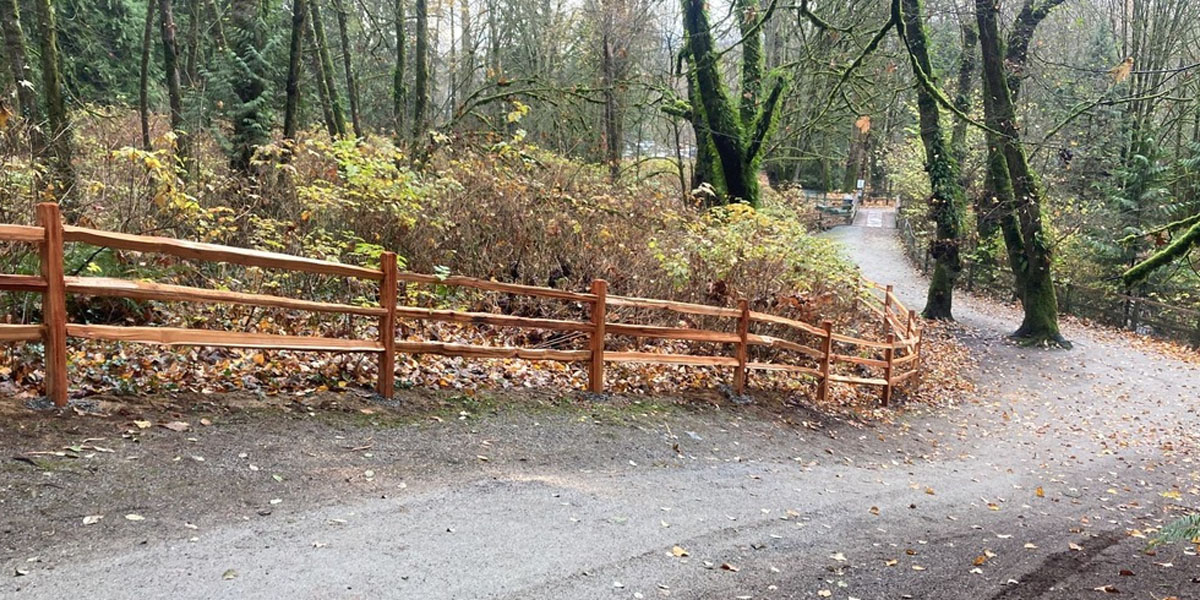
Public parks, trails, and natural areas. Municipalities and parks departments across the Lower Mainland frequently choose split rail fencing for trail boundaries and park perimeters because it defines the edge of a path or green space without disrupting the natural character of the environment. Our installation at Robert Burnaby Park in Burnaby is a good example of split rail doing exactly this job well.
Garden edges and natural property boundaries. On residential properties that back onto greenbelts, ravines, or open space, a short run of split rail fencing can mark a garden edge or property line in a way that feels far less intrusive than a solid fence.
Where split rail does not work well is anywhere that genuine security, privacy, or full containment is the primary goal. Because the fence is open by design, it will not stop a determined pet from squeezing through, will not provide any visual privacy, and will not contain many livestock on its own without an added layer of wire mesh. With people crossing the barrier, it’s even more profound. If your priority is privacy or security, a different product such as chain link, vinyl, or corrugated metal privacy fencing is going to serve you better.
Split Rail Fence Configurations
Most split rail fencing in BC is installed in either a two-rail or three-rail configuration, and the right choice depends on your specific application.
A two-rail configuration is the most traditional and cost-effective option, typically standing around three feet tall. It is well-suited to garden boundaries, trail markers, and general property line definition where the goal is purely visual.
A three-rail configuration adds height and a stronger visual presence, generally standing closer to four feet. This is the more common choice for equestrian paddocks and properties where a slightly more substantial boundary is needed, though as noted above, true livestock containment still requires wire mesh in addition to the rails themselves.
For properties requiring genuine animal containment, whether livestock, horses, or even larger pets, we frequently pair a split rail structure with welded wire or woven wire mesh attached to the inside of the fence line. This preserves the classic split rail appearance from the outside while providing the actual containment function that the open rail design cannot deliver on its own. If containment is part of your goal, this is a conversation worth having with your installer before the project begins, not after.
What Does Split Rail Fencing Cost in BC?
Cost is one of the most common questions we get asked, and it is also one of the hardest to answer with a single number, because split rail fencing costs vary based on several real factors.
The biggest cost driver is simply the length of the fence run. Because split rail fencing is most often used on larger acreage and rural properties, the total linear footage tends to be significantly greater than a typical residential backyard fence, which affects the total project cost even though the cost per linear foot is generally lower than a privacy fence or vinyl fence.
Terrain is the second major factor. Flat, accessible ground with stable soil is straightforward to work with. Sloped properties, rocky ground, or sites with difficult access for equipment and material delivery will increase labour time and therefore cost.
Configuration matters as well. A two-rail fence requires less material than a three-rail fence, and adding wire mesh for containment purposes adds both material and labour cost on top of the base rail installation.
Finally, the source and quality of the cedar itself affects pricing. Authentic hand-split cedar rails typically cost more than mass-manufactured or sawn alternatives, but the difference in strength, appearance, and longevity is significant enough that most property owners find it a worthwhile investment over the life of the fence.
The most reliable way to get an accurate cost for your specific property is a free on-site consultation, since terrain, access, total footage, and configuration all need to be assessed in person to provide a genuinely accurate estimate rather than a generic per-foot number that may not reflect your actual site conditions.
How Long Does a Cedar Split Rail Fence Last?
This is the other question we hear constantly, and the honest answer is that it depends heavily on site conditions, but a properly installed cedar split rail fence in BC’s climate will generally last somewhere between 15 and 25 years, and sometimes longer, without any chemical treatment.
A few factors influence where in that range a given fence will land. Ground contact at the base of the posts is typically the first point of failure on any wood fence, since that is where moisture exposure is most constant. Proper post-setting depth, appropriate concrete or gravel base preparation, and good site drainage all extend the life of the posts significantly. Sun exposure also plays a role, since rails on a south-facing, fully exposed property will weather differently than rails in a shaded, sheltered setting, though this tends to affect appearance more than structural integrity.
This is one of the genuine advantages cedar holds over other wood species used for similar fencing. Because the durability comes from the wood’s natural oils rather than an applied chemical treatment, there is no coating to wear off and no maintenance schedule required to sustain that resistance over time. A cedar split rail fence installed correctly today should still be standing and performing well two decades from now with essentially no maintenance beyond the occasional check for a loose rail or a post that has shifted.
Maintenance: What to Expect Over the Life of Your Fence
One of the most appealing aspects of cedar split rail fencing is how little it asks of you after installation. There is no painting, staining, or sealing required, which sets it apart from most other wood fencing products on the market.
That said, “low maintenance” does not mean “no maintenance ever.” Over a fence’s lifespan, it is reasonable to expect the occasional rail that needs to be reset or replaced, particularly after a significant storm or heavy snow load, and posts in particularly wet or unstable ground may eventually need to be reset or replaced before the rails themselves show any wear. A brief annual walk-through to check for loose rails or shifted posts is a good habit, and catching a small issue early is always less costly than dealing with a larger structural problem later.
If you do notice an issue, replacing an individual rail or resetting a single post on an existing split rail fence is a straightforward repair that does not require replacing the entire fence line, which is one more practical advantage of this style over more complex fencing systems.
Is Split Rail Fencing Right for Your Property?
If you are weighing split rail fencing against other options, it comes down to a fairly simple question: are you trying to define a boundary, or are you trying to create a barrier?
Split rail fencing excels at the former. It is cost-effective for long property lines, it looks genuinely appropriate on rural, acreage, and natural properties, and it asks almost nothing of you in terms of ongoing upkeep. If your goal is privacy, security, or full containment without an added layer of mesh, it is worth having an honest conversation with your installer about whether split rail alone will meet your needs, or whether a combination approach, or a different product entirely, makes more sense.
At Raybern Erectors, we have been installing cedar split rail fencing across Vancouver, the Lower Mainland, and rural BC for over 60 years, sourcing our material from sustainable suppliers, and installing every fence with the attention to terrain, drainage, and structural detail that a long-lasting natural fence requires. Every installation is backed by our COR-certified safety standards and a 1-year parts and labor warranty.
If you are considering split rail fencing for your property, we would be glad to walk the site with you, talk through configuration options, and give you a clear, honest estimate based on your specific land.
Recent Split Rail Projects

Frequently Asked Questions (FAQs)
Post spacing typically falls between eight and eleven feet depending on the specific rail length being used. We will confirm exact spacing during your site consultation based on the rails we are sourcing for your project
Not typically on its own, since standard split rail height is well within a deer’s jumping range. If wildlife exclusion is a priority, a taller, more solid barrier is usually a better solution, though split rail can still serve a complementary boundary-marking role.
Permit requirements vary by municipality and are generally more relevant for fence height and proximity to property lines than for fence style specifically. We can advise on local requirements during your free consultation.
Yes. Our team has experience installing split rail fences on a wide range of terrain types across BC, including sloped rural properties. Post depth and spacing are adjusted to suit the specific contours and soil conditions of your land.
On its own, no. Because split rail fencing is open by design, most dogs can pass between the rails. If containment is your goal, we recommend pairing the split rail structure with welded wire or chain link mesh attached to the inside of the fence line.
Related Posts